 AdventuresNW



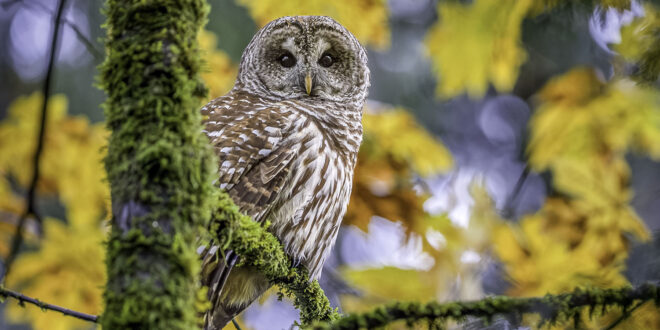
Most public policy conflicts have well-defined opposing camps. Left vs Right, Rich vs Poor, Permissive vs Puritanical, the Yankees vs the Red Sox, etc. Yet sometimes a policy decision is so knotted that even similar minds find themselves at odds. This is where the finer points of ethics and morality become deeply explored. Such is the case with the barred owl in the Pacific Northwest.
Let me set the stage…
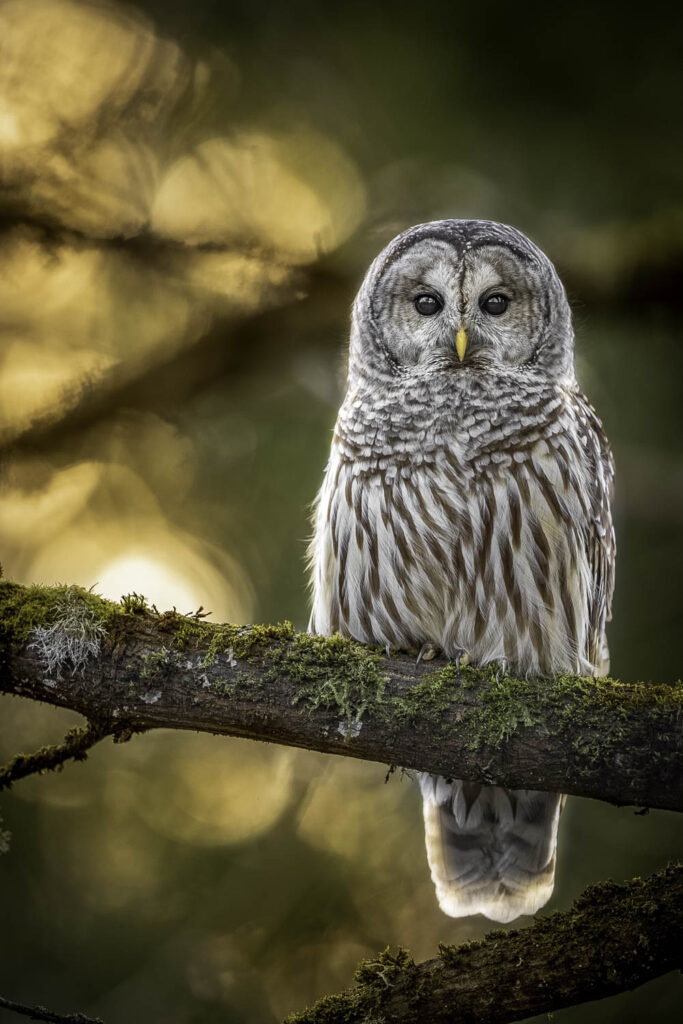
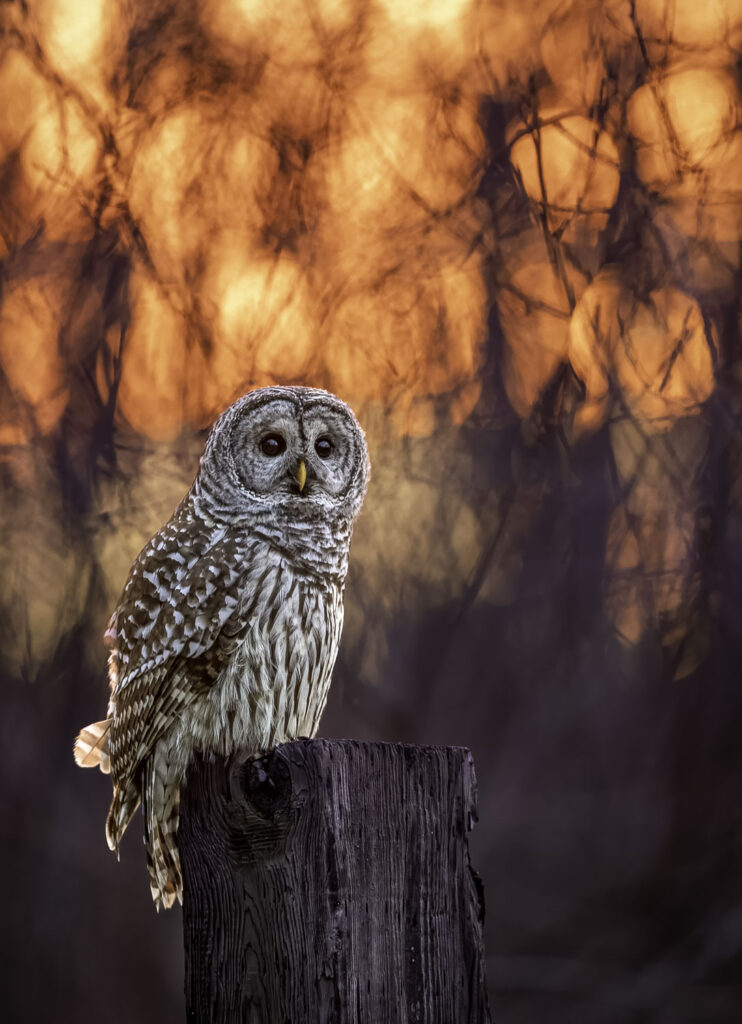
A hundred and twenty years ago, the barred owl lived east of the Mississippi River. A large and adaptable bird of prey, the barred owl is an opportunistic hunter with a wide range of targets, from insects to small mammals, fish, amphibians, and smaller birds. If something is knocking around the forest at night, there’s a good chance the barred owl wants to eat it. Barred owls prefer dense forest but will happily move to open woodlands if the opportunity arises.
This awful conundrum has been brought upon us by our own ongoing practice of meddling with nature when we are best served by leaving it alone. It’s a story as old as human history.
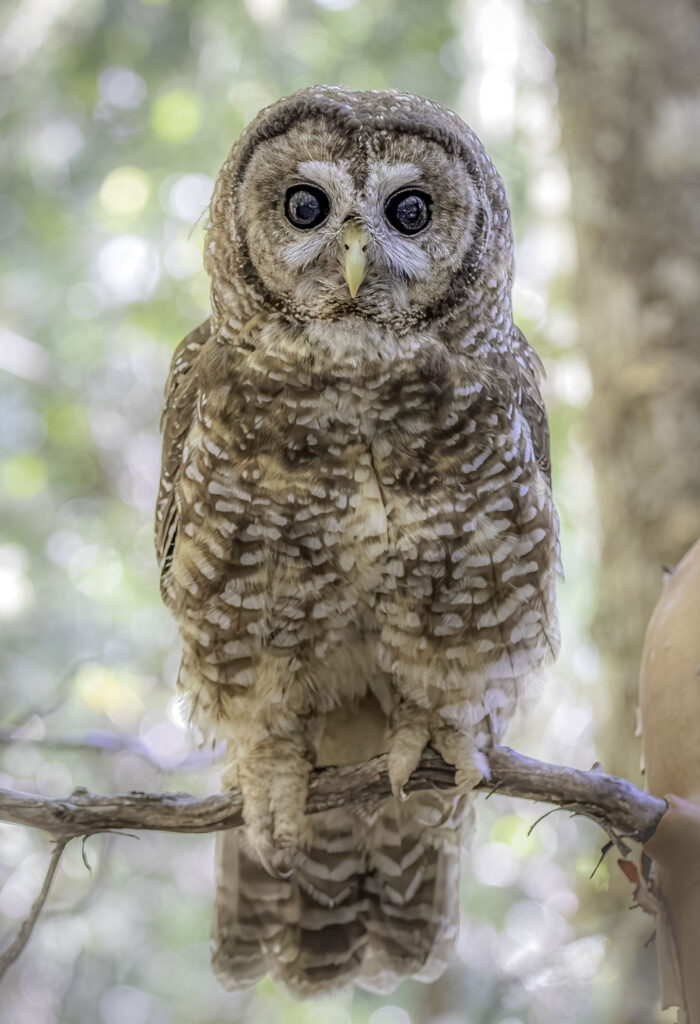
Far away, in the old-growth forests of the Pacific Northwest, lives the northern spotted owl, a smaller and more fragile cousin of the barred owl. These denizens of the dark mossy forests eat insects and various small mammals, but they have a preference for flying squirrels, voles, mice, and gophers. In a pinch, they’ll hunt what they can, but these natives of the Pacific Northwest are finicky eaters. They are also very particular about where they nest, living solely among the majestic giants of the northwest’s ancient temperate rainforest.
Then, as the twentieth century unfolded, peculiar things happened.
Human beings in America and Canada started planting trees across the Great Plains. These trees were a mix of tree farms and municipal ornamentation. Suddenly, the Great Plains were sporting something new: places to perch.
In the West, human beings developed new and innovative ways of extracting staggering numbers of trees from the vast forests that seemed to stretch to infinity. A continent-sized thirst for lumber and wood products was emptying the Pacific forests, year after year.
Throughout all of North America, climate change started making incremental increases in average temperature over decades, affecting everything from weather patterns to hurricanes. Things were changing. Fast.
Some barred owls left their shrinking habitats in the east, migrating north across Canada where new stands of trees had suddenly appeared, offering them a tempting option to keep moving west. It wasn’t optimal, but it was better than Baltimore. They continued moving westward, hopping between tree farms and suburban groves.
In the Pacific Northwest, the northern spotted owl was in an increasingly challenging position. Its ancient forests were being extensively clear-cut and sold off at bargain prices. Unwilling to relocate to the wooded suburbs, the northern spotted owl hunkered down into ever-smaller pockets of old-growth forest. Their numbers dwindled sharply.
In 1970, barred owls started appearing in Oregon forests. These plucky easterners made new homes in Oregon and Washington, just like the humans who were also moving west in droves. This unusual owl arrival was duly noted by bird biologists, but by the 1980s, all eyes had turned to the plight of the northern spotted owl.
Horrified by the rapid destruction of old-growth forests, conservation groups latched onto the plight of the northern spotted owl as a public policy wrench to crack open the armor of the lumber extraction industry. The northern spotted owl became a cause célèbre, appearing in pamphlets, white papers, magazine covers, and even refrigerator magnets. Public pressure and a clear scientific consensus led to listing the northern spotted owl as threatened under the Endangered Species Act. This precipitated new moratoriums on old-growth deforestation, which in turn caused a simmering culture war between rural loggers and environmentalists, known as the “timber wars”.
Since old-growth forests had themselves become endangered by that time, opportunities for lumber extraction plummeted. Timber sales in Oregon dropped to less than 0.5 billion board feet in 1996, down from an annual average of 2.9 billion board feet in the 1980s. It seemed the northern spotted owl had gotten a reprieve, but it was too little, too late. Its population continued to decline. Owl counting is tough work, but various studies showed a 65-85% population decrease between 1995 and 2017. Despite the action to preserve its habitat, the northern spotted owl was not doing well.
When the barred owls settled into areas ruled by the northern spotted owl, tensions rose. The barred owls were bigger and happy to encroach on the northern spotted owl’s forest homeland. The northern spotted owl, being less aggressive, got pushed further toward oblivion. Recent studies show a 2.9% average annual population decrease for spotted owls in recent years, despite fewer changes to their habitat. Conversely, the local barred owl population had increased about 1.1%, year after year. It seems the new threat to the spotted owl is the barred owl, not the chainsaw.
This brings us to today, and to the policy conflict.
Among other things, the United States Fish and Wildlife Service (USFWS) is charged to “…(work) with others to conserve, protect, and enhance fish, wildlife, plants and their habitats for the continuing benefit of the American people.” Part of that mission is enforcing the Endangered Species Act of 1966. And that means protecting the northern spotted owl.
Duty-bound to act, the USFWS put together a management strategy to protect the beloved northern spotted owl from the depredations of its carpetbagger cousin, the barred owl. The USFWS gathered studies and testimony from owl biologists, forestry experts, and conservationists to develop a game plan based on conclusions from the Final Environmental Impact Statement (2024a), which concluded that the barred owl was a direct threat to the northern spotted owl.
The USFWS developed six options for action, which varied from “do nothing” to “cull barred owls across entire physiographic provinces.” In the end, they decided to go with Alternative #2: the culling of barred owls within and around spotted owl sites. Culls will occur in General Management Areas located around the smaller, focused spotted owl sites (Focal Management Areas), which will be continually identified. Their reasoning is thus: “Spotted owl populations are projected to increase the most under Alternative 2, due in part to the added focus on managing current and recently occupied spotted owl sites.”
(It’s worth noting that despite the cull, the barred owl will not be extirpated from the Pacific Northwest. Their population should stabilize in areas outside the General Management Areas.)
The word “cull” is a bit of a weasel word, so let’s be clear about what we’re talking about. The USFWS is planning to kill as many as 15,000 barred owls every year for the next thirty years, ultimately killing as many as 450,000 barred owls. Vetted hunters armed with barred owl calls and shotguns will carry out the work. Shotguns, we are told, are the most effective and humane method for culling owls. Furthermore, the USFSW Record of Decision concludes that the noise of the shotguns won’t be especially problematic for the spotted owls and their forest friends.
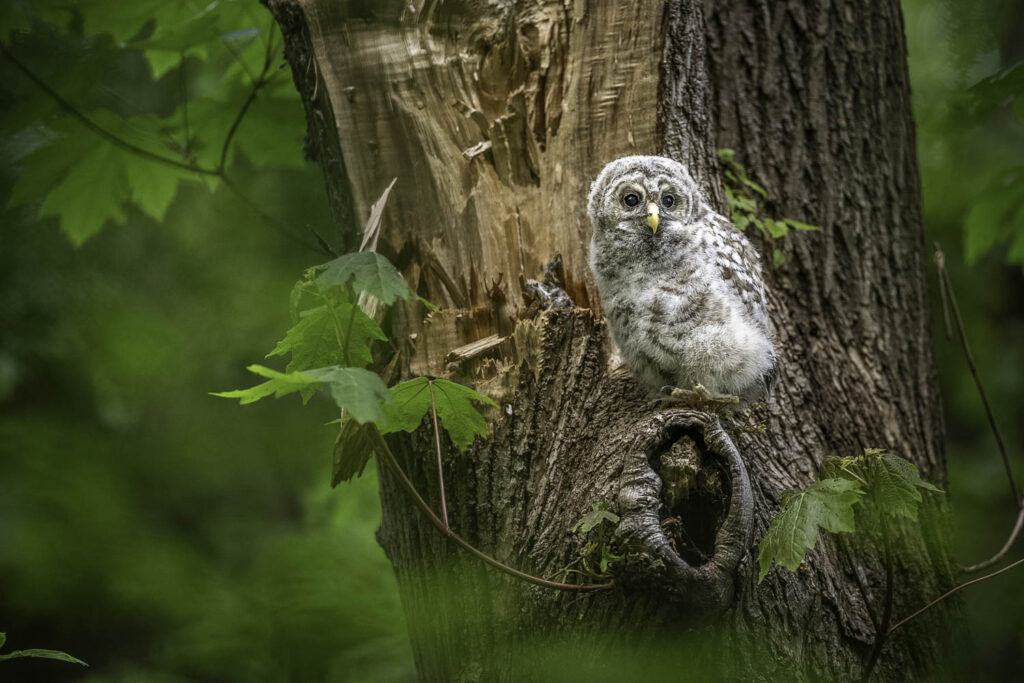
The feasibility of this plan has come into question. Owls are famously elusive creatures. In her excellent book What an Owl Knows, author Jennifer Ackerman describes in detail the challenges that experienced owl biologists face simply observing owls in their natural habitat. Getting one good photograph of a reclusive owl can involve a number of long, sleepless nights in cold, wet conditions. Owl biologists, it turns out, are a very tenacious and long-suffering group. It causes one to wonder whether part-time hunters with a shotgun are up to the task.
According to the USFWS, it can be done. Based on their study, barred owl calls lure these invasive owls away from spotted owl areas and can then be shot on sight. Per the Record of Decision, the chances of a tragic mistaken identity are vanishingly small, with the likelihood of a northern spotted owl getting shot somewhere below one per decade. Limited tests resulted in 71 barred owl kills with no losses or ill effects on spotted owls. Whether this test is a valid pilot that bodes well for the project is a subject for debate.
The choice to go with Alternative #2 caused an immediate stir between two largely overlapping activist groups: conservationists and animal rights organizations. Northwest conservation groups have long held the northern spotted owl as a symbol of the struggle to preserve wild places. Their successful battle to halt the destruction of old-growth forests was conducted under the banner of saving the spotted owl. They are dismayed and disheartened that the northern spotted owl continues to spiral toward extinction.
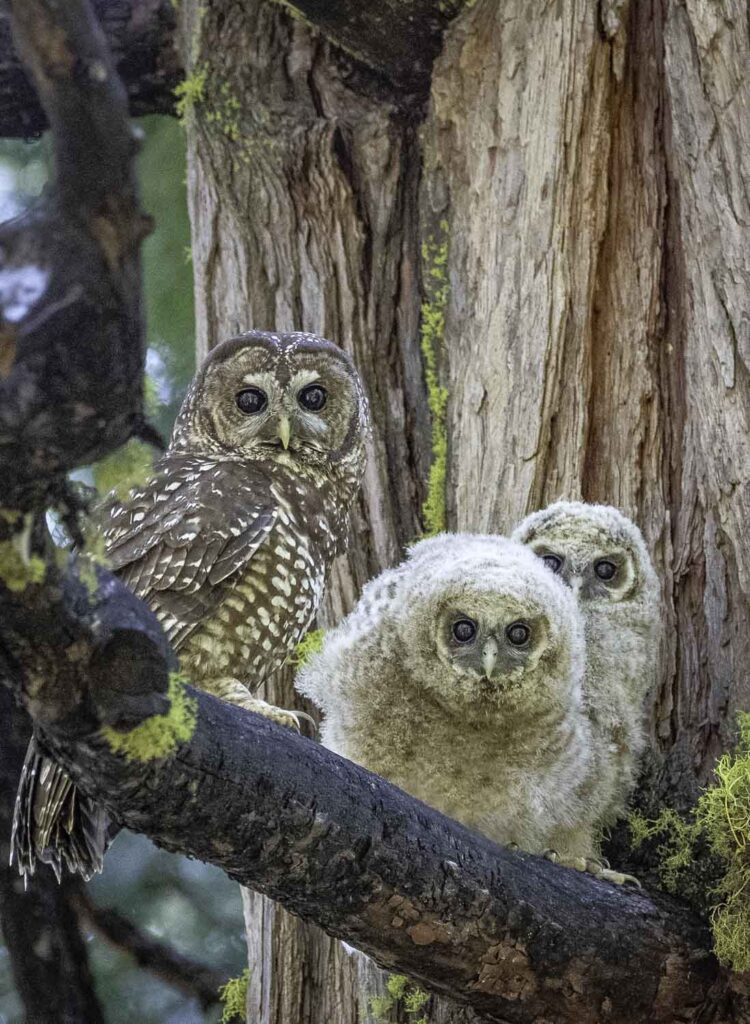
Established organizations like Conservation Northwest and the Marin Audubon Society have regretfully agreed that the barred owl cull needs to happen. They are not thrilled that it has come to this, and the decision is wrenching, but they have defended the spotted owl for forty years, and they aren’t going to abandon it now.
Mitch Friedman of Conservation Northwest writes, “The plan to outright kill barred owls to save spotted owls is necessarily drastic and emotional. For some, the emotion is an understandable aversion to the violence. For me, it’s despair at how human errors have disrupted the beautiful ancient forest ecosystem. I can’t be resigned to that change, or the further impacts barred owls have on that ecosystem. We must give spotted owls a chance at survival, and this is our only way to do so. Thankfully, there is reason to hope that it will work.”
Friedman’s words echo those of many, including the USFWS itself, which has––through exacting academic language––admitted this decision comes after long, painful reflection and not from a desire to wipe out barred owls.
Of course, there are detractors.
Animal Wellness Action and the Center for a Humane Economy have publicly stated their vigorous opposition to the plan. These animal welfare organizations have historically been very close ideologically to the conservation movement. Rarely do these two camps find themselves at odds. Each wants a better world where the oafish destruction wrought by humanity is checked.
For their part, Animal Wellness Action has stated:
“This inhumane, unworkable barred owl kill-plan is the largest-ever scheme to slaughter raptors in any nation by a country mile,” said Wayne Pacelle, president of Animal Wellness Action and the Center for a Humane Economy. “It calls for unidentified, unspecified individuals to be allowed to kill barred owls over 24 million acres of federal, state, and private lands — including invading national parks such as Olympic, Crater Lake, and Redwoods National Parks at night to shoot owls that look like spotted owls. It has a zero percent chance of success, but it will produce an unheard-of body count of a long-protected owl species native only to North America.”
Clearly, there is a difference of opinion between conservationists and animal welfare groups.
Each has clear-eyed opinions about the cull, but neither side relishes the idea of blasting 450,000 barred owls with shotguns. This awful conundrum has been brought upon us by our own ongoing practice of meddling with nature when we are best served by leaving it alone. It’s a story as old as human history.
Overpopulation, pollution, habitat destruction, and the introduction of invasive species have resulted in unintended consequences since Bronze Age societies began mining copper and tin, and the Romans slaughtered thousands of exotic animals in the Colosseum for fun. As time went on, humans got worse, not better. In many cases, we tried fixing our bad decisions by introducing more bad decisions as counters. The case of the barred owl may be yet another example.
Time will tell if the regional cull of the barred owl actually takes place. Activists are issuing lawsuits, and the practicality of the cull remains uncertain. If the cull does begin and continues for thirty years, we will know if our continued meddling does any good or if it simply backfires, which is too often the case. The best possible outcome would be the stabilization of barred owl and spotted owl populations. If these two cousins can coexist, it would be a rare success story of human meddling. If they cannot coexist, then it seems the days of the northern spotted owl are numbered.
 A longtime member and chairman of the Bellingham Greenways Advisory Committee, Ted Rosen can often be found on local trails complaining about litter. He is also a skilled guitarist and a student of history.
 Based in Longbranch and Alki, Washington, 22-year-old photographer Isabelle (Izzy) Edwards intimately captures the wildlife and landscapes of the Pacific Northwest. Best known for photographing all 19 North American owl species, her work highlights local biodiversity and inspires conservation through visual storytelling. Visit her at isabelleedwardsphoto.com.



At this point in human history, it seems ecosystems in true sense of the word
no longer exist. Logging, mining, urban sprawl, even intensive farming, have
turned the planet into an almost completely human made environment. What
we basically are doing to preserve biodiversity now, is more or less large scale
gardening. Culling Barred Owls is another example of this. A very unfortunate,
but necessary example. I understand animal welfare groups dismay, but Barred
Owls are faring very well yet, the population in their “native range” are plentiful,
and are now vastly out competing their less adaptable cousin in it’s native range.
Culling Barred Owls is at this point, is another step in our continued fight to save
biodiversity. However unsavory it may seem.