AdventuresNW



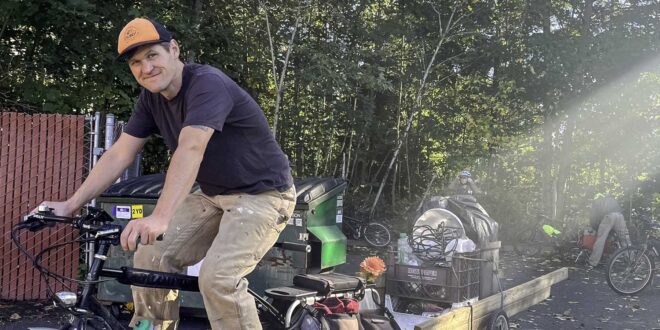
Troubled by the increasing levels of trash along Whatcom Creek in Bellingham, Washington, Matt Bryant decided to do something about it, and Trash Club was born in 2020. Bryant brought the idea to The Hub Community Bike Shop, a Bellingham-based non-profit committed to keeping waste out of landfills by building refurbished and custom bikes with donated frames and parts.
What prompted you to start Trash Club?
In 2020, I started noticing trash piling up along the banks of Whatcom Creek. I hated to see the creek trashed in that way, and I thought somebody should do something about it. I had a classic a-ha moment in realizing that I’m somebody, and I could do something about it. So, I started going down to the creek once a week to pick up litter. Eventually, I started inviting friends to join me and then decided to see if strangers would like to join in the work. To my surprise, people showed up. And people have continued to show up––in over four years of monthly clean-ups, there has always been someone new at every clean-up. Given the minimal promotion and outreach I do for the group, people continue to show up for the work. It’s inspiring to me.
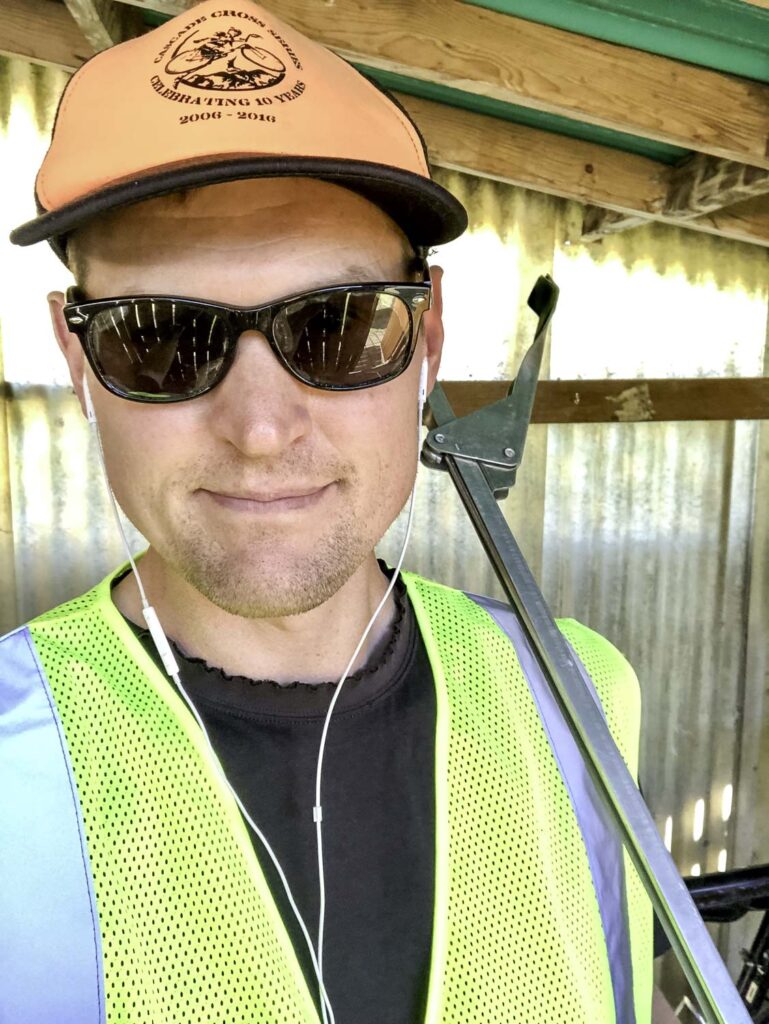
The subtext here is that in 2020 with COVID the housing crisis started intensifying, resulting in more folks who were forced to live outside. With nowhere else in the downtown zone to camp, they started camping along the creek. Without adequate services (restrooms and trash) to support these campers, their waste started accumulating along the creek. This is not to blame the people in that unfortunate situation, but it is to blame the city for not providing adequate services to people in need (we can and should do better as a community, and I’ve shared that with our city council members on a few occasions, trash slideshow and all). This work is an effort to provide these community members with an essential service while protecting our local ecology.
Also worth noting: we start each clean-up with a land acknowledgement, which goes like this: “We acknowledge we are on the homelands of the Lummi and the Nooksack people who stewarded this land for thousands of years with minimal environmental impact and who were displaced less than 200 years ago by settlers who came to this area seeking profit. We acknowledge that the litter we clean up is part of the legacy of these settlers, and we acknowledge our work is in some small way an act of reparations.” I believe it’s important to put this work into context.
Amid so much negativity and polarization, why is it important to volunteer oneself in service to the greater community?
People come out because they want to help out. It feels good to take action to address a problem. During a time when we face so many problems, many of which we can do very little about, it feels good to address a problem that we can do something about. We are not powerless–all of our collective outcomes are the cumulative effects of the choices we each make as individuals. If I clean up all of the litter in the area, and the next day it gets trashed again, it was still worth cleaning it up because every action counts in the grand sum, and because it feels good to put your values into action.
What are the personal benefits for the volunteers?
See above. Also, meeting interesting people, having profound and hilarious conversations, using fun equipment (ever used a grappling hook to retrieve a soaked sleeping bag from a whirlpool?), and cool trash finds.
How many participants come out?
We average 10-12, with a range of 5-25.
Has the trash situation improved?
Marginally. The city is doing more than it used to, which is appreciated, but it’s still not nearly enough. This situation won’t improve until we address some of the underlying issues. In the case of Whatcom Creek, it’s the lack of services for unhoused folks. Until we have adequate services for those who are unable to access traditional services, the impacts will be felt by the entire community.
But if we zoom out and consider the state of our broader community, has the trash situation improved? No. We are living in a throwaway culture of convenience with a constantly flowing waste stream of disposables. Most folks with housing make a staggering amount of trash in their own lives, but they have the convenience of hiding it in a giant bin and having it picked up every week. That trash is just as ugly as the trash that ends up along the creek. All trash ends up somewhere.
What’s your relationship with The Hub?
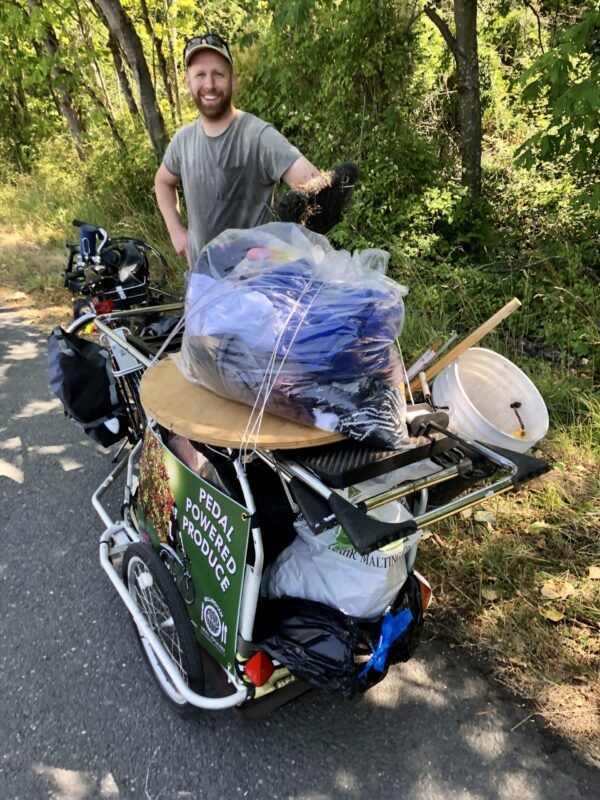
I’m on the board of directors, and I coordinate our community programs, which include our community education classes and Trash Club. Trash Club might seem like an odd project for a bike shop, but it fits well with the mission of The Hub, which is to protect the environment and serve our community through waste stream reduction, consumer education, and promoting and supporting alternative transportation. And The Hub is essentially a waste processing center anyway, so we have some helpful tools and the space and services to do this work.
Also, I love bikes, and using bike trailers to haul stuff, so that has been how we’ve hauled all of our trash, about 80 tons at this point, since July 2021.
Is this kind of thing happening in other places?
Yes. Through the internet, I have made contact with other community litter clean-up groups, and even a few others that are bicycle-powered. There is a dedicated group in Portland, for instance.
What do you do when you’re not picking up trash?
I’m parenting my cool 13-year-old kid (who often comes to Trash Club), or I’m working my full-time job at WWU, or I’m working on my tiny house build, or I’m trying to engage with and contribute to my community, or I’m riding my bike, or I’m playing strategy games, or I’m meditating and writing poetry.
Trash Club meets from 1-4 p.m. on the first Sunday of every month at 110 Ohio Street. Bikes or other alternate forms of transportation are recommended but not required. Volunteers should bring work gloves, closed-toe shoes, and drinking water. Contact the club at bhamtrashclub@gmail.com.