AdventuresNW



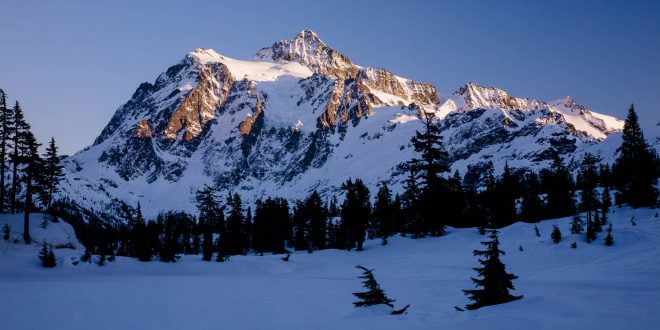
What I remember most is golden light. That, and a sense of the downhill edge, tucking the downhill knee up and feeling taut on that thin line. I could convince myself that no matter how steep the spire, just angulating on that edge would hold me.
In warm light, belief is easy. A grey day would freeze my confidence like a corpse in blue ice. As it is, the soft evening light projects me onto a movie screen, and the skier in the film does one pedal jump turn after the other until the summit pyramid of Mt. Shuksan is behind him and the gentle slopes of the Sulphide Glacier fall away in a thousand turns.
My heart is pounding as I pull over the edge, and I notice that the sky seems a deeper blue than I ever recall.
We have no intention of skiing from the summit of Shuksan; we plan to simply ski the Sulphide Glacier. Frith Maier, the doyenne of early mountain starts, rouses us in the dark at some ungodly hour. She tells Tim Greer and me that we need to get going to beat the afternoon’s wet snow, and if our eyes won’t focus and our heads hurt, things will be better once we start moving. We have about three miles of road to traverse, then forest and ridges to ascend, before starting up the mountain proper on the Sulphide. With the complexity of the route and the sheer length (about 11 miles from our car and 7500 vertical feet), Frith is undoubtedly correct.
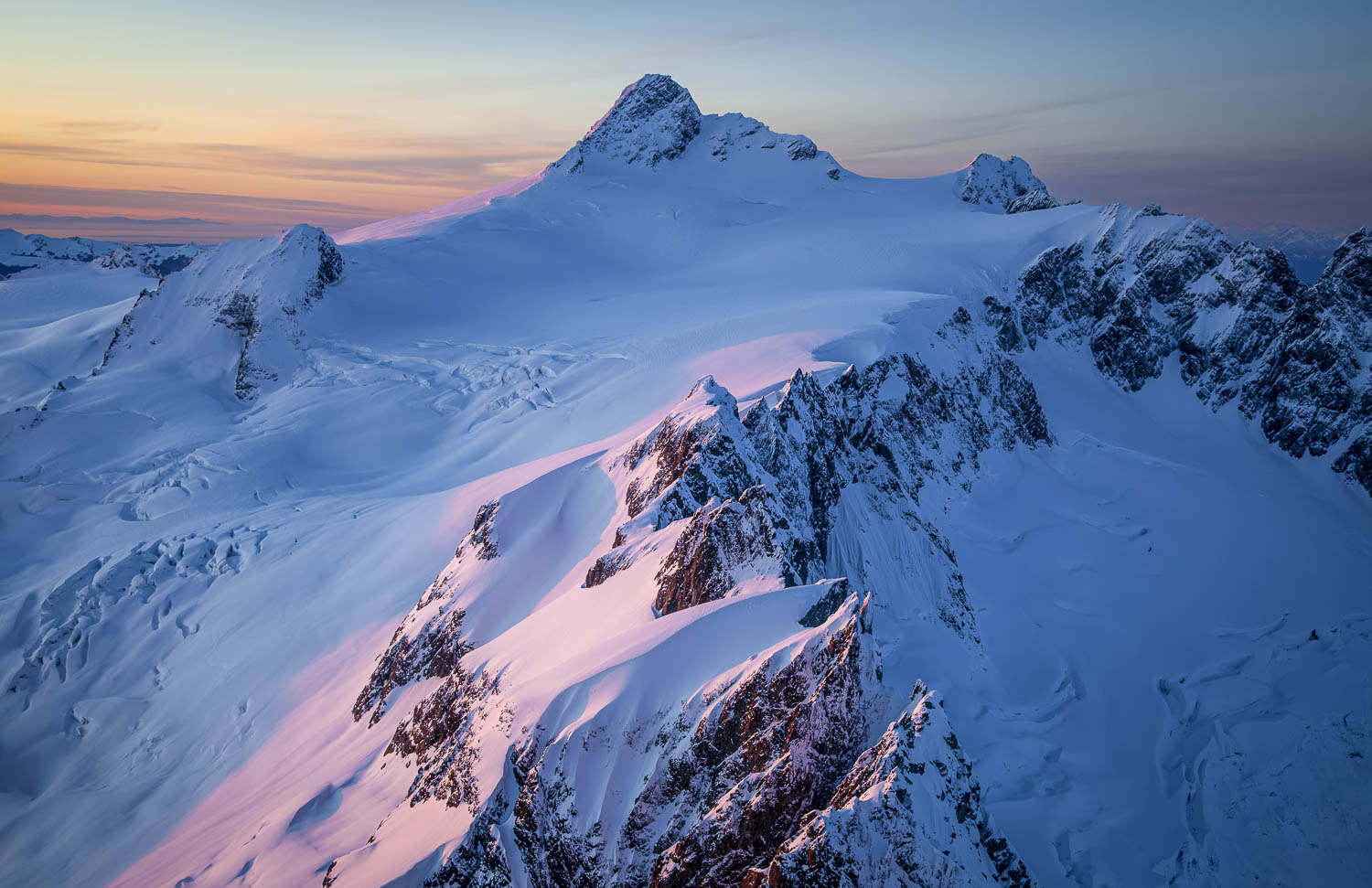
The coffee she places in my hands gets me out of my sleeping bag faster than the logic of her argument. I don’t expect to reach the distant summit—that’s not the plan. And it would be difficult to convince anyone who knows the Sulphide glacier, an expanse of low-angle snow, that one high point would be much different from another, so turning around before the top doesn’t seem problematic. The sun comes up as we rhythmically pace up the road.
You can sense a warm day before it actually happens when you’re skiing uphill. It’s lovely just to let the sweat come and hypnotize yourself with steady breathing as the morning unfolds. Your legs carry the burden upward through colder and colder climate zones, about three degrees per thousand feet, on average. But on a day that’s going to be as warm as this, the sun can warm the air three degrees in a minute. Reality shoves aside the reverie of the climb, and I start to worry about avalanches.
A warm day could loosen wintry slabs. Happily, this is the fourth warm day in a row, so we think that most melt-induced slide activity would likely be over, unless it is significantly warmer this day than the last few. But we have no way to make accurate comparisons of recent temperatures up here, and anyway, why even worry about snow sliding? The Sulphide Glacier is too flat for avalanches.
Other problems soon occupy me. Blisters. Dammit! Someone who has skied for decades has no business getting blisters in any kind of ski boots. Luckily, Frith carries a complete first aid kit including a Styrofoam cup, which turns out to be the best blister treatment ever invented. She whips out some duct tape and repairs my raw heels. As we sit just below a notch at 5400 feet, I survey our position. The snow is softening perfectly now for a rapid ascent with an inch of corn on a solid base. Off we go again.
The seductive curves and shadows of the Sulphide lure us forward. The glacier is without crevasses and maintains a perfect angle for a non-switchbacking ascent. The sibilant hissing of our skins as they slide over the snow creates a soundtrack in the silent air.
Beyond the notch we climb in earnest. One roll of the Sulphide after another yields to our upward progress as we hum along like tuned engines running at full bore and even stroke. We’ve been transformed into wordless machines, crawling upward, taking only short breaks for refueling and watering. If you observed us, you’d think we were determined to reach the top of Mt. Shuksan, but any goals are vague in our minds, which at this point are dulled by the exertion. Yet, we are exhilarated by the vast glacier we’re climbing, and by Mt. Baker and the Picket Range that dramatically dominate the scene.
We cover miles across the white treadmill before I stop to look up again. There, I see a white tower. I shout, and we all pause to take in Shuksan’s summit pyramid, a spire as out of place in this white desert as Devil’s Tower in the green hills of Wyoming. No one mentions climbing the thing, but as we resume the upward march, I realize I now do have a goal.
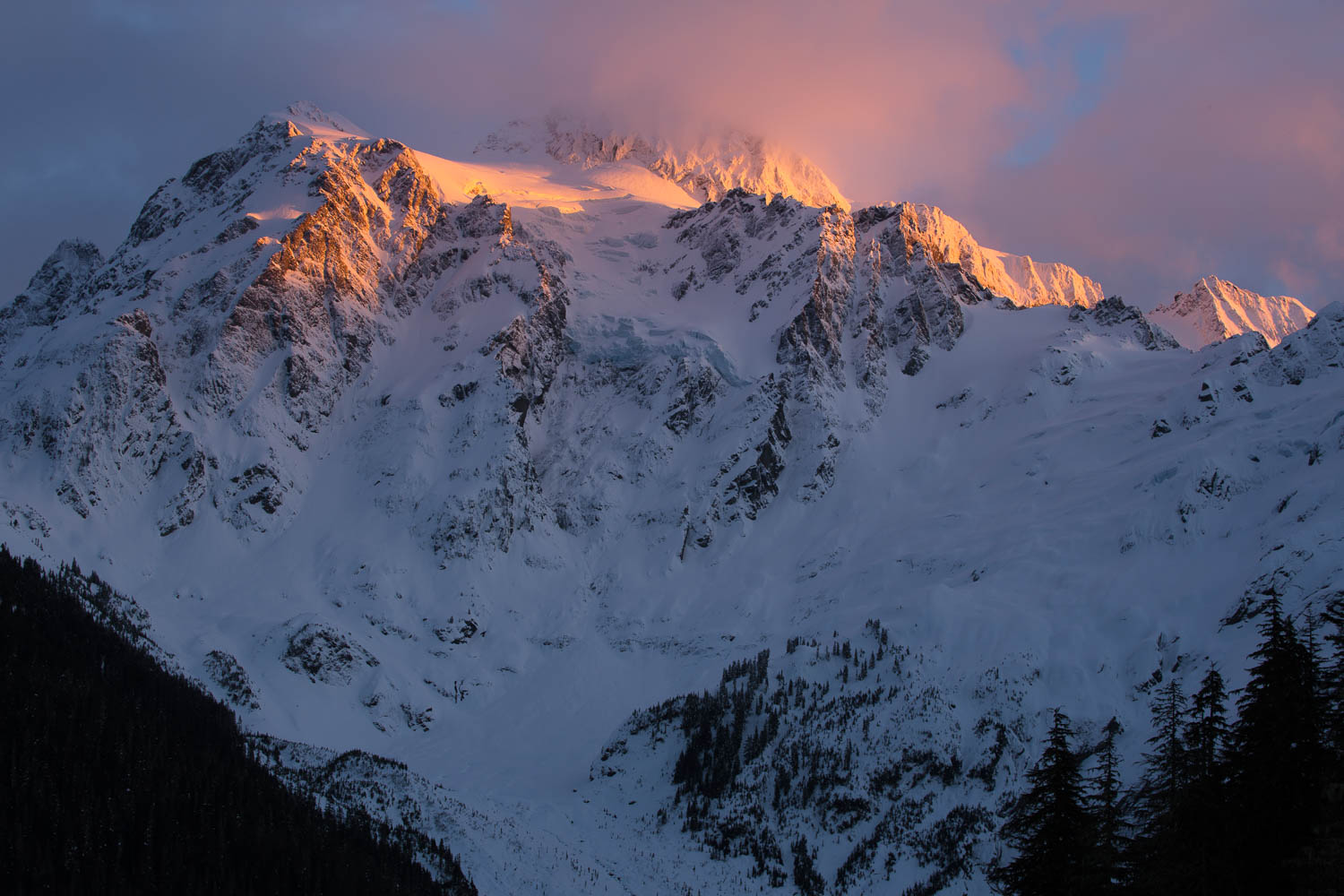
An hour later it looks only a bit larger, and I tell myself that such things always look steeper than they really are. We notice three dots moving slowly upward in a couloir leading to Shuksan’s true summit. After another hour, we are close enough to make out three climbers descending from the summit cornice into the couloir, which faces south. It takes them nearly an hour to descend the pyramid, kicking steps and belaying one another.
Finally, the three of us assemble at the base of the couloir; it’s about 3 pm. Tim, on telemark skis, decides to forego the ascent. The advent of light randonnée ski gear allowed me to justify abandoning my beloved telemark skis on a trip like this. But as I look up at the softening south couloir, I know I’d never have the nerve to do a jump telemark turn in such a place.
A chute narrowing in width from 50 down to 20 yards sweeps upward to the summit rocks, pasted with snow and rime. The previous party’s tracks jog to the left just short of the summit and disappear over a cornice. Frith and I start up the gully. I’ve got my self-arrest (“death grip”) ski poles and have my skis strapped to my pack. Frith has an ice axe and leaves her skis.
We swing into step-kicking mode, with ice axe and death grip for handholds. From the summit, small rocks are falling down the gully as the sun warms the mountain. Snowballs spontaneously form and roll past us. Inexplicably, I feel strong even after climbing 7000 feet up the Sulphide. The surface snow is about four inches deep, quite soft, and under it is a crusty layer. On the final push to the summit, the cornice rolls upward to near vertical. My heart is pounding as I pull over the edge, and I notice that the sky seems a deeper blue than I ever recall.
Frith and I mount the final rocks to the summit, and I realize I’ve wanted to stand here for years, but never set out to climb this beautiful peak, not even today. Yet here I am, and I feel a bit lightheaded as I survey the spectacular scene before me, now with deepening light as the day tips toward evening.
Yellow rays bathe the summit, the cornice, and the southern couloir beneath us. Instead of leaving my skis tied to my pack and downward step kicking, I remove them and click into their bindings.
Edging up to the brink, I visualize the landing after leaping from the cornice: the downhill edge, the tuck of the knee. The sun seems to be setting even as I stand there, and then I’m off into the yellow couloir, with each turn a little freefall followed by an edge set.
Below lies flat ground, the Sulphide, and now it too is golden. I realize it’s getting late and I’m in this very steep place. I’m amazed that ski edges can hold me in a place like this; a place where boots alone would never work, where skis are like a form of ice crampon… a very special crampon that can hold you securely but also slide effortlessly down a steep gully, down a huge sloping glacier, down miles of ridges and forest, down trails and road, all the way down to the car which waits in the darkness of the woods, below the shining tower.
Golden light is what I most remember—that, and a sense of the downhill edge.
 Brian Povolny is a retired orthodontist who indulges his love of moving through nature by rock climbing, backcountry skiing, cycling, and sailing. A long-time resident of Seattle, he also enjoys writing about his experiences in our beautiful region.