AdventuresNW




Was this the worst coffee I’d ever tasted? A definite possibility.
Clearly, the pot had been sitting on the burner for many hours (days? weeks?) with just enough viscous liquid in the bottom to pour two cups, one for Susan and one for me.
We were sitting in a somewhat shop-worn restaurant perched above the shores of the Strait of Juan De Fuca on the outskirts of Clallam Bay, the designated meeting place to reconnect with our old friends Barb and Rich, who had driven up from southern Oregon to meet us for a few days on the Olympic Coast. When I say “old,” I mean both that we’ve known each other a long, long time (more than 40 years) and that, yes, we were all getting undeniably long in the tooth.
Although it’s undoubtedly an exciting and stimulating experience to visit a place for the first time, as the years have gone by, I’ve come to recognize a comparable joy in revisiting beloved places, a rhapsodic contentment akin to coming home.
We had orchestrated this meeting at the restaurant, not because we had a fetish for horrible coffee but because we were planning a backpacking excursion to a beloved destination on the wild Olympic Coast, a place all of us had visited before, Shi Shi Beach.
Shi Shi is an almost mythic place, a coastal Shangri La. Perhaps the most beautiful beach on the west coast of these United States. Truth be told, the entire stretch of coastline that comprises the western edge of Olympic National Park is inordinately beautiful, and I’ve hiked almost every step of it from the Hoh River in the south to Shi Shi in the north: miles and miles of splendor—soft sand, towering sea stacks, eagles, whales, and tide pools full of strange and wonderful creatures. Wind-swept headlands a hiker can only reach using climbing ropes, sculpted driftwood logs scattered around like the pick-up sticks of giants, contorted forests, moss gardens, and lichens swaying in the wind that blows almost constantly off the vast Pacific. But even among all this splendor, Shi Shi Beach stands out for its beauty and high drama.
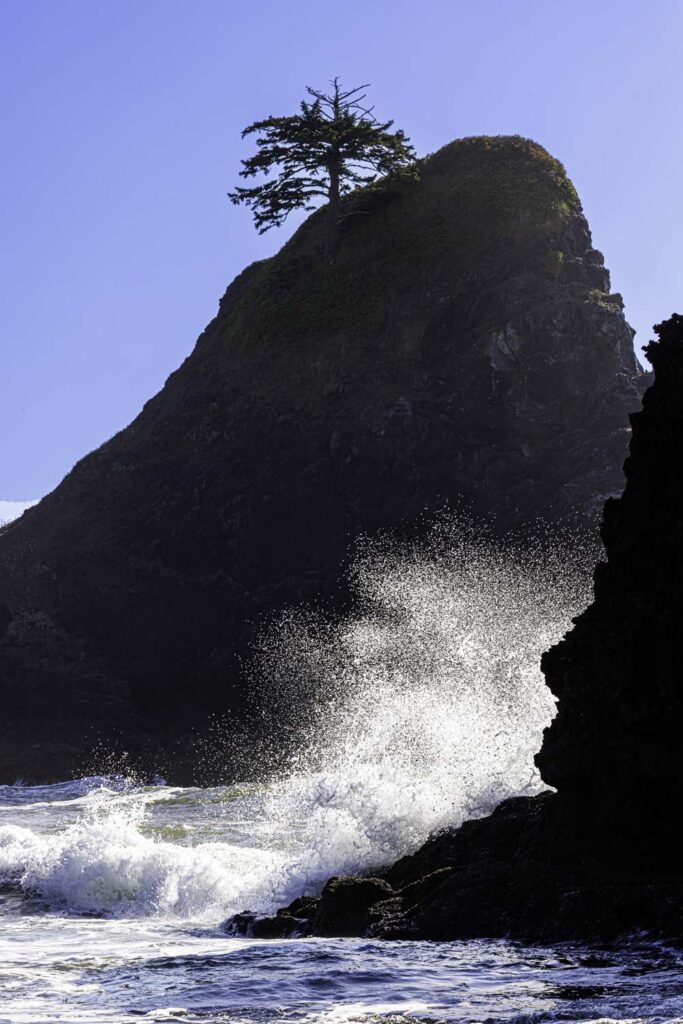
How many visits have I made to Shi Shi? Twelve, maybe thirteen. My first sojourn was back in the 80s. I was immediately transfixed. I’ve never visited this beach as a day trip. No, that would be like stopping in at the Louvre for a half hour. Spending a night or four is the only way to truly appreciate this special place; camping above the tideline, one has sufficient time to savor the lullaby of crashing surf, a sound that combines the blood pressure-reducing benefits of white noise with the rhythmic pounding of the waves, the heartbeat of the Earth.
But years had elapsed since I had last visited Shi Shi.
I reluctantly drained my coffee cup, and we paid our tab, exited the restaurant, and headed west toward the edge of the continent.
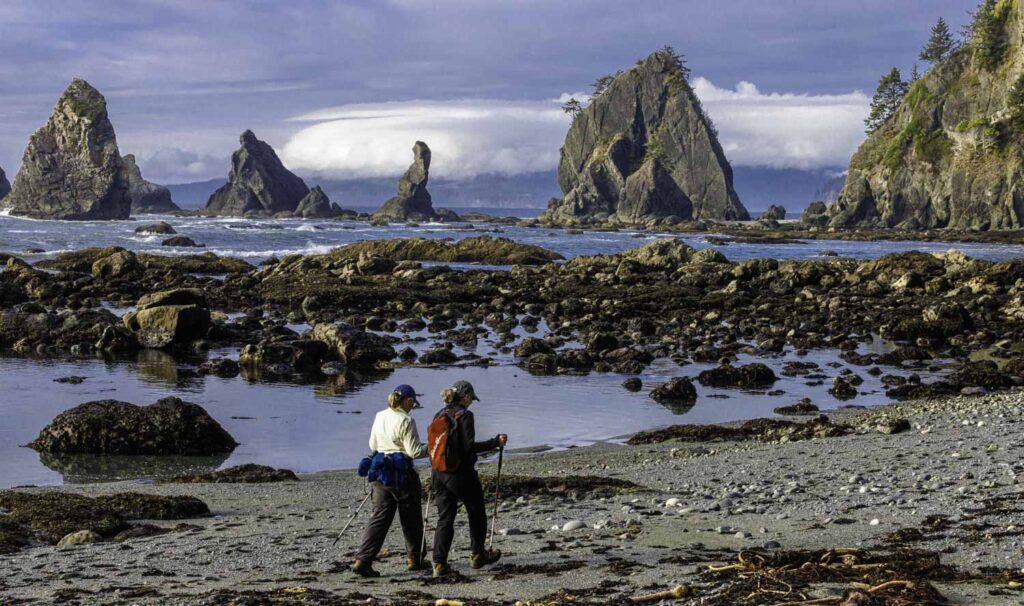
Backpacking at Shi Shi Beach involves an array of permits: The beach is part of Olympic National Park and, as such, requires a backcountry permit issued by the Park Service. But the trail—largely constructed on tribal lands—requires a Makah Recreation Permit. I’d purchased the park permit online before leaving home and now procured the Tribal permit at the Makah Cultural & Research Center, located in Neah Bay. This windblown town, situated on the shores of the Strait of Juan De Fuca, is the focal point for the tribe and the center of culture, commerce, and—increasingly—tourism-related activities. Traditionally a fishing village, Neah Bay now offers restaurants and resorts, although its somewhat ramshackle charm remains.
From Neah Bay, we continued west toward Cape Flattery, famous for being the most northwestern point in the contiguous United States, before turning south on Hobuck Rd., tracing the shoreline of Makah Bay to the Shi Shi Beach Trailhead, where we unloaded our packs. Rich and I then drove a half mile back down the road to the last house on the road to park the cars, a place that long belonged to a Makah elder named Tilly. This is the tradition at Shi Shi, and I’ve been happily paying Tilly to park in her backyard for something like 30 years. But sadly, we learned that she had passed away over the winter, and her niece and her niece’s husband now lived there and ran the parking concession. We paid the parking fee and hiked back to the trailhead, hoisted our packs, and headed into the intensely green coastal rainforest.
Years ago, the trail into Shi Shi was an infamous mud fest, forcing hikers to negotiate boot-sucking ankle-deep mud on the abandoned road that served as the trail through the woods. In 2003, the Makahs, funded by grant money, unveiled a greatly improved trail (featuring cedar plank boardwalks and a unique cantilevered bridge) for the first portion of the 2.1-mile route to the beach. We made our way through the forest on the puncheon walkway, which, after a mile or so, predictably deposited us back into the mud for the rest of the way. Some things never change.
After reaching the National Park boundary, we climbed down from the headland to the beach, using the newly constructed stairs provided by the Park Service (years ago, this was a rope-assisted descent), and stepped out of the trees onto the sand of Shi Shi Beach. The sun sparkled on the water, and seals bobbed in the surf as if to welcome us.
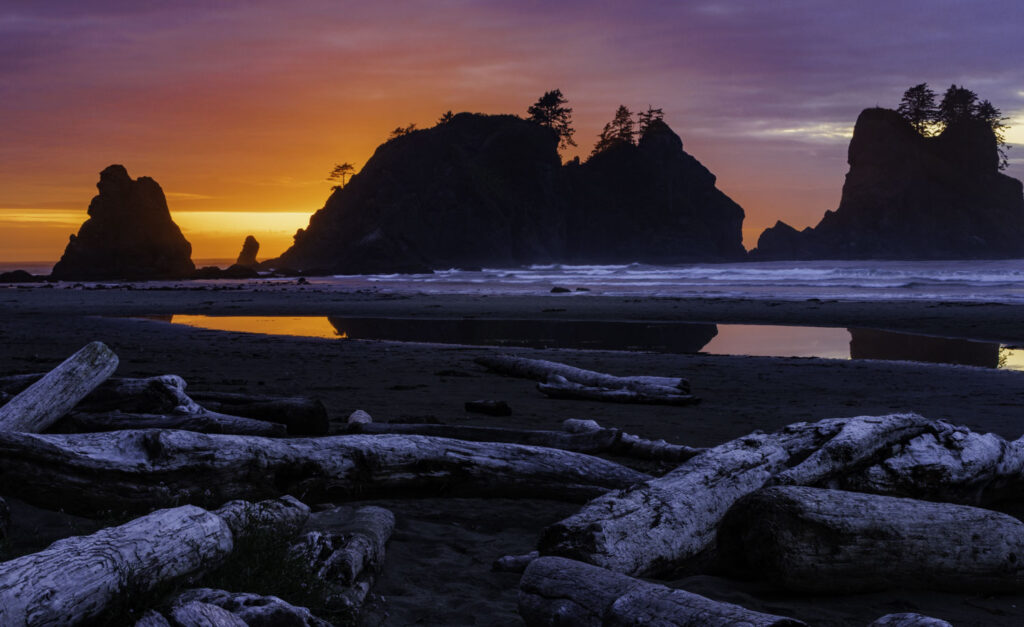
Turning left, we hiked along the edge of the sea on a retreating tide, which provided easy walking on hard-packed sand below the characteristic jumble of driftwood beach logs that formed a picturesque sculpture garden at the top of the beach. Our destination was the south end of Shi Shi near the magnificent Point of Arches, a collection of dramatic sea stacks some 2.4 miles away. After a mile of walking, the distant presence of Petroleum Creek was heralded by a flock of seagulls gathered at its mouth (it’s often difficult to discern where creeks are from a distance on the Olympic Coast, and I’ve learned to spot them by the birds that invariably gather there). We crossed the inches-deep creek (causing the seagulls to rise up all around us like an Alfred Hitchcock movie) and continued toward the Point of Arches, where we found a beguiling place to pitch our tents beside a shimmering reflecting pool above the high tide line. This pool is what remained of Willoughby Creek, the last trickle of fresh water on the south end of the beach. At this time of year, the creek itself disappears beneath the sand before reaching the ocean, but some exploration in the dense coastal forest above the beach revealed the creek proper, still flowing through the tangle of greenery, and drinking water was assured.
We made dinner as the setting sun painted the sea, sand, and sea stacks in shimmering orange and magenta, reflected like an impressionist painting in the mirror-like surface of the pool. Afterward, we sat in the gloaming, watching night fall on the restless Pacific, before crawling into our tents to drift off to the music of the waves.
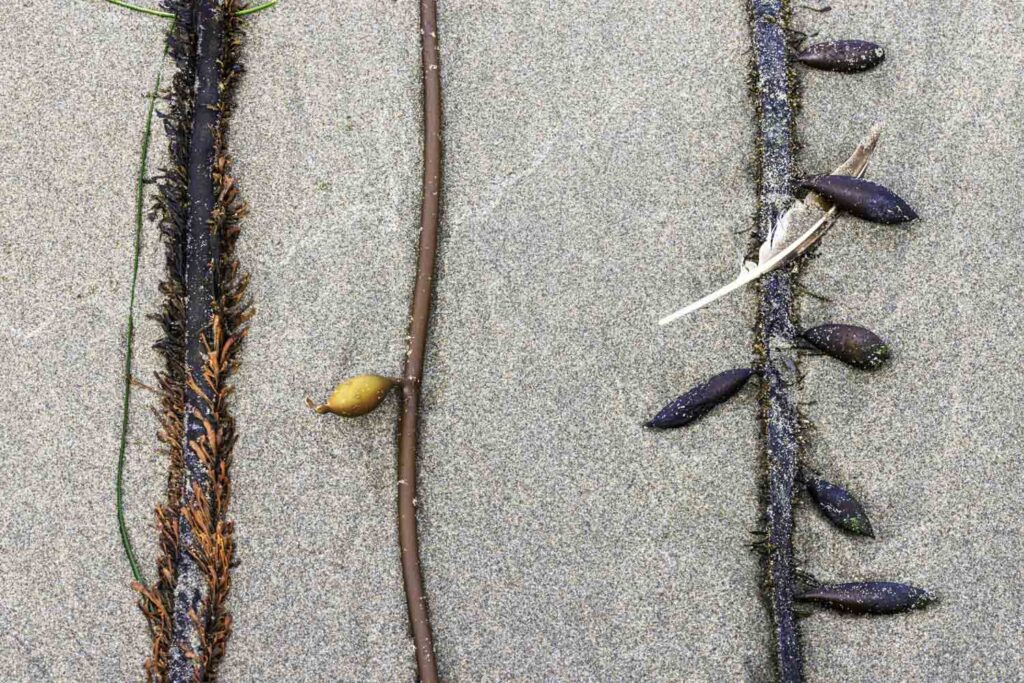
The overnight pattering of rain showers tapered off at first light, and we emerged from our tents one by one, enjoying morning coffee beneath the thinning clouds. We aimed to head south, rounding the Point of Arches, but doing so was possible only at low tide, and the tide was up, so we spent the morning exploring the beach to the north and admiring the complicated tapestries of seaweed in iridescent Day-Glo tangles that decorated the sand. I’ve always had a well-developed aesthetic appreciation for flotsam and jetsam. As the tide slowly withdrew, the clouds rolled away, leaving a cobalt-blue sky.
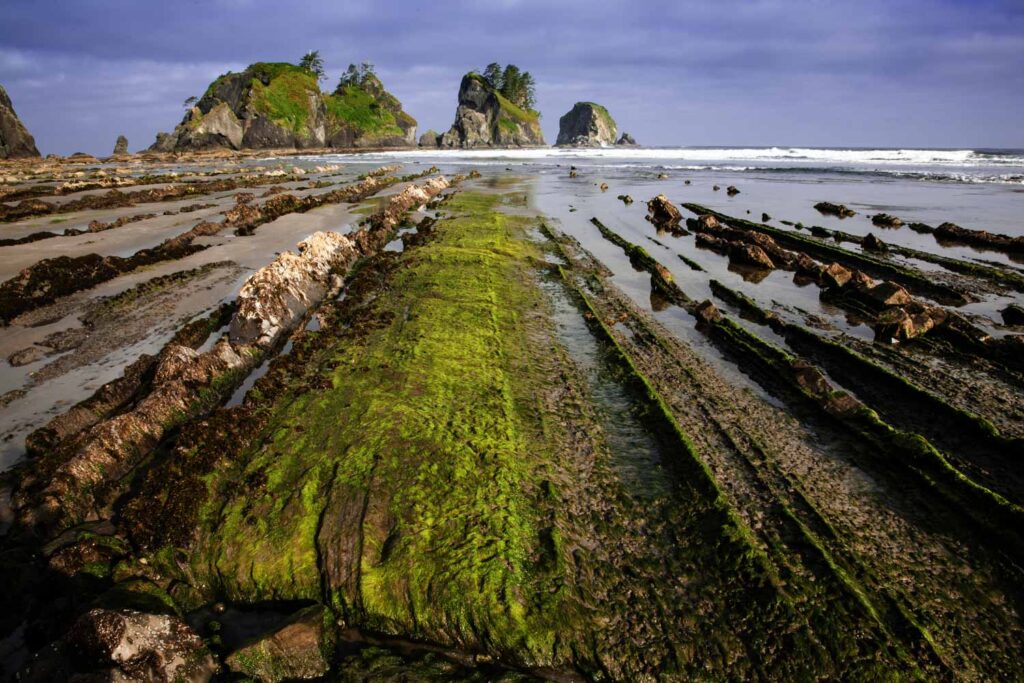
By early afternoon, the tide had retreated sufficiently to allow passage to the south, and we carefully negotiated the seaweed-covered rocks around the point, gaining access to the lovely crescent beach beyond the Point of Arches. This nameless beach is a personal favorite and quite different from Shi Shi: cobbled with pebbles that clatter and hiss as the waves ebb and flow. Large, fancifully eroded rocks rose from both sand and surf like rune-covered relics, and my progress slowed as I stopped often to photograph the beguiling scrimshaw patterns that adorned every surface.
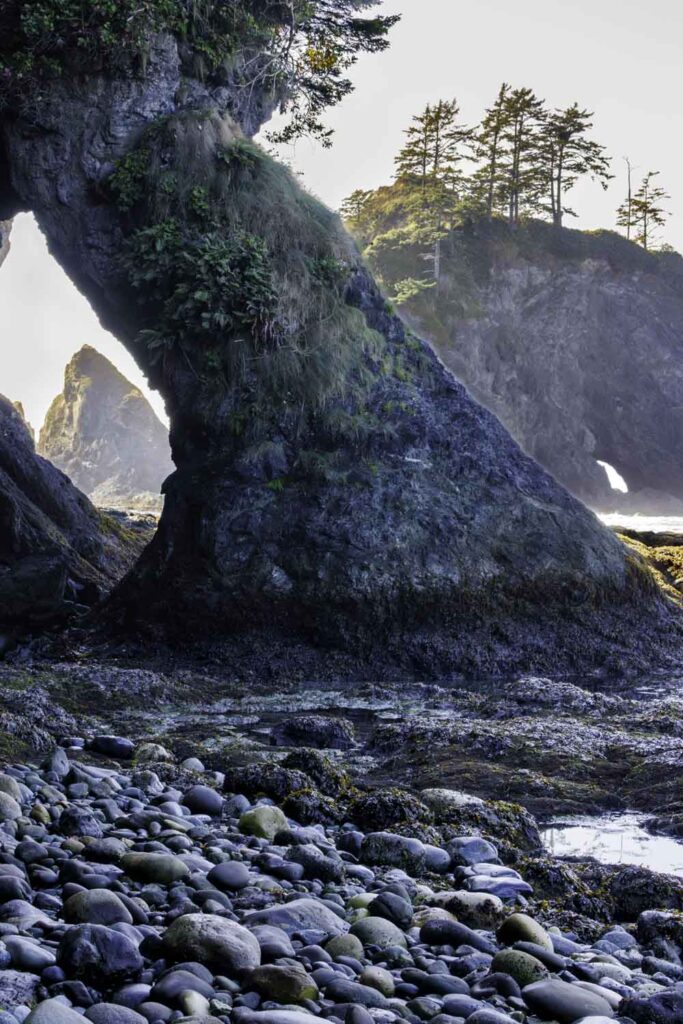
On the far end of this beach, we scrambled over more seaweed-covered rocks toward a graceful sea arch, slipped through a narrow crack in the towering stone cliff—invisible until the last moment—and stepped out onto a hidden pocket beach beneath the majestic stone pinnacle known as the Totem. Giant sea anemones crowded the tide pools and we stopped to sit on a rock in the sun beside them to savor the wild scene, the tumult of the pounding waves sending spray into the sky beneath sea stacks and arches resplendent in the warm sunshine.
On previous trips, I had climbed the rope-assisted route up the headland to the south to a small cliff-top prospect known as the aerie, reached after crossing a knife-edge ridge, an excellent place to gaze straight down into the maelstrom of crashing surf (and to watch passing whales). Today, however, we were content to sit on smooth rock for an hour and contemplate the grandeur of the mighty Pacific.
All too soon, it was time to head back to camp, mindful of the rising tide. We made our way back through the crack, among the rocks and technicolor seaweed gardens, rounding the point in early evening.
Another spectacular sunset from camp, sky aglow with deep purples and burgundy against the convoluted silhouettes of the Point of Arches. Leaning back in my Therm-A-Rest chair, I was filled with a sense of deep contentment. Much had changed in the world in the past 40 years, but moments like this beside the sea remained timeless. I don’t have the language to adequately express the joy and solace this realization engendered.
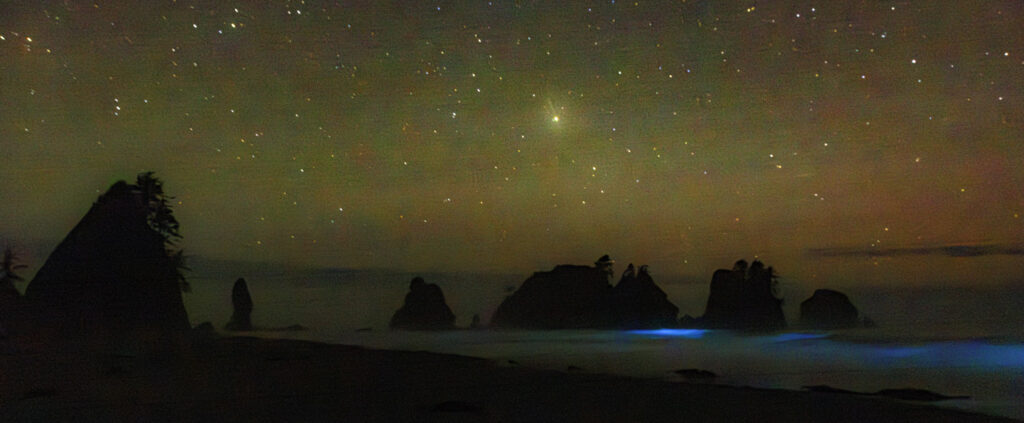
After dinner, we noticed strange flashes of brilliant blue in the surf—bioluminescence! The breaking waves danced across the sea, flashing with a brilliant azure light, illuminating the darkness. We wandered the sand in the dark, watching the light show, captivated by the electric sapphire glow, a sort of grand finale to a day of ecstatic beauty. One by one, the others turned in, but I lingered at the ocean’s edge for a long time in the darkness, enraptured by the spectacle of light provided by both bioluminescence and a hundred thousand stars.
There are so many places that call to me, places I return to again and again, places that hold power and memories. Although it’s undoubtedly an exciting and stimulating experience to visit a place for the first time, as the years have gone by, I’ve come to recognize a comparable joy in revisiting beloved places, a rhapsodic contentment akin to coming home. An opportunity, perhaps, to connect to the fluttering spirit that moves within us.
Permits
Two permits are required for overnight trips to Shi Shi Beach, as are bear canisters. A Makah Recreation Permit is issued by the Makah Tribe, available at the Neah Bay Mini Mart, Museum, or Marina. The NPS Permit is available from Recreation.gov. Bear cans can be rented at the Olympic National Park Visitor Center in Port Angeles. Overnight parking is available at the private homes located about .6 miles back down Fish Hatchery Road (the way you came).