AdventuresNW




I’m still trying to figure out what I want to be when I grow up. At the current moment, I find myself sitting on the couch next to my wife–the kids are in bed, and I’m staring down the barrel of my 35th birthday. I suppose you could accuse me of “Peter Pan Syndrome”, never really wanting to grow up, although most days my life looks more like the opening scenes of “Hook”. I grew up in the Idaho Panhandle, where each day my mother drove us to school. We would cross the Spokane River, and I watched the small but mighty tug boats pushing log booms from some distant slope across the lake to one of the many mills then situated along the river, now remembered only by the word cleverly placed into whatever restaurant or bookstore stands in their place. I was mesmerized by the jaunty little vessels, and whenever questioned about my future career ambitions, I quickly exclaimed, “I am going to be a tugboat driver!”
Shoulders drop, smiles spread, and good conversation has us all forgetting about our devices.
Boats were always a part of my life. A water skier’s son, I grew up spending endless days beside the crisp, clear waters of Priest Lake. Some of my most vivid memories involve pitching tents on the sandy shores of Kalispel Island and evening “jammy rides” on dad’s 19-foot bowrider. We passed the flickers of what seemed like hundreds of campfires while ribbons of smoke filled the still evening air. Little did I know that those jammy rides would plant a seed deep in my consciousness, a passion for boating that would eventually lead me toward a maritime existence. I suppose there was a purity to it all, a deep peace that would leave any sane person hungering for more.
I took to sailing in my late teens. The local college held an outdoor program on the shores of Lake Coeur d’Alene. The bright and whimsical colors of the Hobie Cat sails reliably adorned the beach on any summer day. My friend Jon is a sailing evangelist of sorts and ran the program at the time. I doubt he knows that he changed my life the day he handed me the single sheet and shoved the tiny vessel off the beach. I’ll never forget the joy of soaring over the waves and the terror of realizing that I had to sail back somehow. I got the hang of it. A shoal with a small rock island at the other end ran just a few yards off the beach at Tubb’s Hill. When the wind was just right, I could come in hot, yank the rudders up at just the right moment, and slide through the gap in style, a stunt that the local kids called “threading the needle”.
While I may have fallen short of tug boat glory, my “career” as a captain has taken me to many places, and that, in itself, has taken many forms. It wasn’t long ago that I sat longingly in the bilge of a millionaire’s yacht tied alongside the pier in the Elliot Bay Marina. A global pandemic was swarming, my wife was due with our first child, and I’d just returned from a month-long delivery through the Panama Canal and across the Caribbean. I was doing the thing, yet I was still met with a sinking sense of despair. I quietly wondered, “If you could do anything you wanted, no rules, what would it be? Where would you be? Could you earn any money? Could you be a more present husband and father?”
The term “boatstruck” is often used to describe the mystical, transcendent moment when a skipper lays eyes on their muse. In my case, I would have sworn that it was some magnetic disturbance coinciding with the shift of a tectonic plate that drew me to my ship, but as she is fastened completely with silicon bronze, the mystery remains. I’d finished up a delivery of some uninspired Clorox bottle-of-a-vessel and was engaged in the usual time-wasting exercises while I awaited the ferry—a trip to Admirals, a stop for pho, and a stroll through the shipyard. I hadn’t woken up that day with any expectation of a life-altering encounter, yet as I rounded the corner into the final rows of hopeful vessels, there she was. A schooner. My schooner. She was a bit worse for wear with peeling paint, ripped canvas, cracked seams, and withering rigging, but I didn’t care. I have always had the gift, or curse, of seeing things not for what they are but what they could be. When I looked at her, I saw the world. Our paths were destined to become one, although neither of us knew it at the time. Filled with instant infatuation, I nearly missed my ferry. I put her out of my mind and attempted to return to the ins and outs of normal life. Weeks later, as I engaged in my evening ritual of scanning Yacht World, I nearly jumped from my seat when I saw that the very same vessel from our brief encounter was indeed for sale.
I’ll cut here and save you pages and pages of excruciating detail on how I couldn’t afford it, the logistics were impossible, I didn’t know what I was doing, it would never work, you’ll shoot your eye out, kid, and all the rest. Naval Ravikant claims that the universe is rigged in such a way that if you want one thing, not ten, not three, but one––you can have it. Six months later, I was loading a pickup truck full of tools and supplies and heading out to bring my boat home come hell or high water. This mission wasn’t going to be about aesthetics, or sailing, or showmanship. This was about making the boat float and getting it back to Anacortes, where the refitting could continue in hopes of running our first charters the following spring.
A friend and I spent seven days working from sunup to sundown and often into the night. I can recall collapsing into my bunk at the end of those first hot August nights and spotting stars through the open seams in the deck. Add that to the list. When splash day finally came, I didn’t know whether to jump for joy or crumple under the crushing reality of the mountain still ahead to climb. I suppose this conundrum illustrates something of a constant state of being for the traditional wooden boat owner. It can be hard to imagine why anybody in their right mind would sign on in the first place, but I’m not one to let practicality get in the way of a good romance.
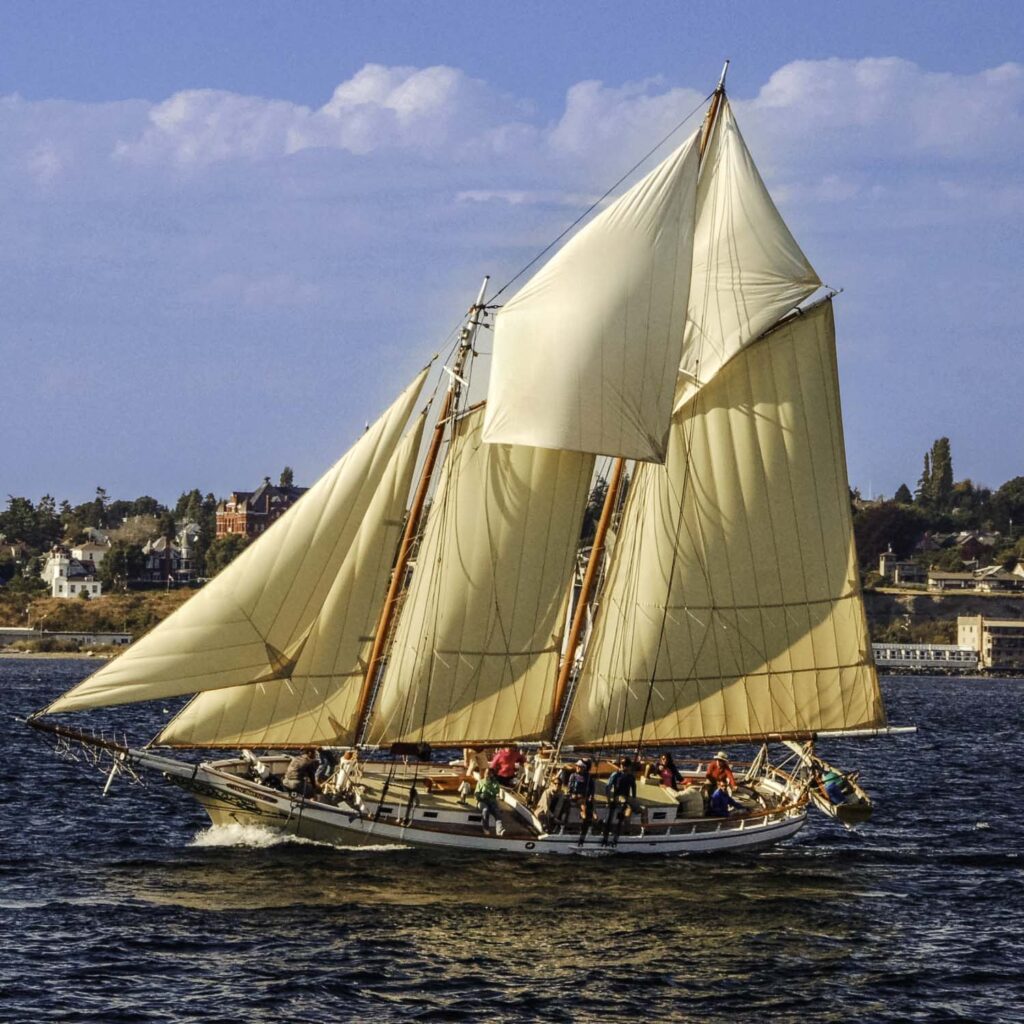
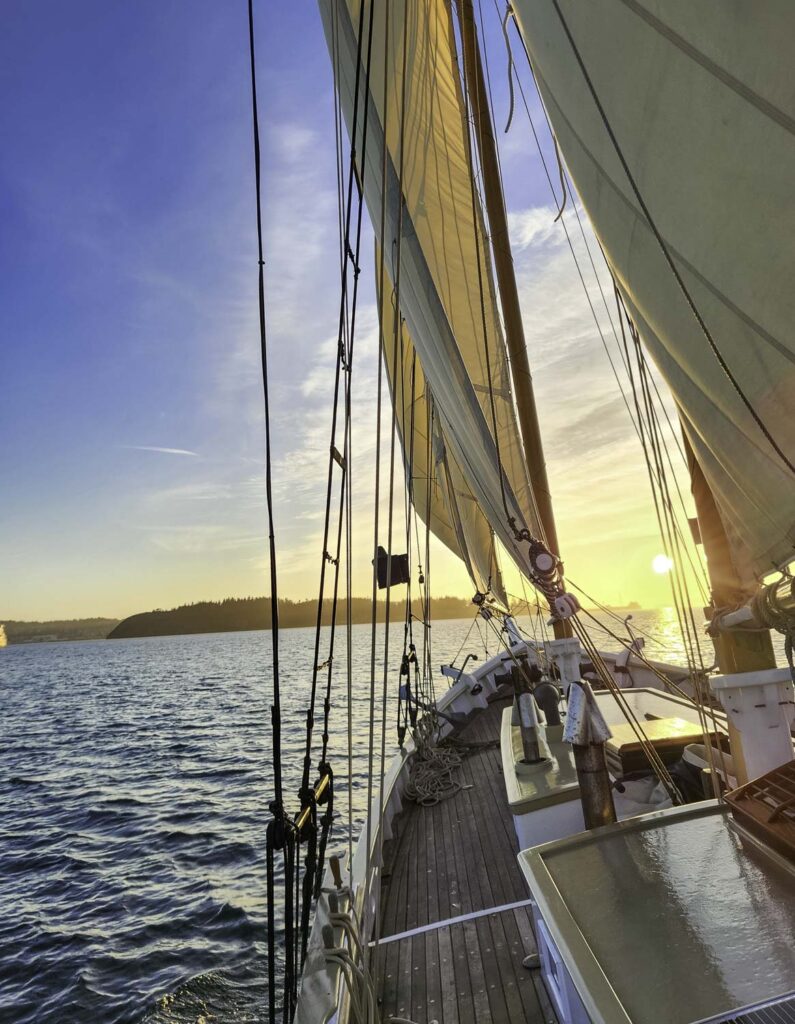
Setting sail, we took in the glory of the Salish Sea as we closed the miles toward home. Gybing the boat and sailing the final miles through the Guemes channel and into Fidalgo Bay, we began to notice strange little tufts soaring by in the quartering breeze. A quick investigation confirmed that it was not dandelions but the vessel’s original three-strand mainsheet disintegrating and blowing away, with only a few shredded strands remaining. I rushed to employ the main boom preventer as an emergency sheet and took up slack just as the tired sheet parted. Add rigging to the list as well. The refitting continued, and to this day, I’m not sure where the “refitting” ends and the “routine maintenance” begins. “Set the hook and paint something” soon became the company motto. By April of 2023, she was safe and had received just enough paint to pass as a respectable sea-going schooner. My company, Sail Anacortes and the Schooner Anse La Roche have now carried thousands of guests through the wild islands of the Salish Sea.
Bringing a public, traditional sailing presence to the Anacortes waterfront has been something that I’m quite proud of. Anacortes has a long history of maritime trades and activities, and it’s amazing to imagine a schooner like mine hauling salmon to a coastal cannery a century ago. In recent years, I’m afraid that this rich maritime history has faded as focus shifts toward other industries and tourism attractions. In a hectic and technologically advanced world, it can be a real gift to unplug and see the world much the way that one would have in a bygone era. It’s always a joy to witness the moment when a spirit of relaxation sweeps across the deck. Shoulders drop, smiles spread, and good conversation has us all forgetting about our devices. If you happen to be over the age of 65 and sitting in one of our beanbag chairs, well, in that case, you have a fifty-fifty chance of being asleep, lulled by the gentle sea and the sounds of waves lapping on cedar planks.
While we sail a full calendar of sunset sails and day trips to nearby islands, our voyage to the Port Townsend Wooden Boat Festival is quickly becoming the crown jewel of our season. Anse La Roche sets sail each September with an eager crew of wooden boat enthusiasts bound for the Olympic Peninsula, with overnight stops at Deer Harbor (Orcas Island) and Watmough Bay (Lopez Island) to take in the island life. Swimming, hiking, eating, and laughing help to set the mood before we point our bow across the Strait of Juan De Fuca. It’s not uncommon on this crossing to be engulfed in a late summer fog, dropping a misty grey veil over the surroundings and robbing us of the perceptions we otherwise take for granted. This environment offers a unique opportunity to light the oil lamps, set out our radar reflector, sound the appropriate signals, and communicate with other vessels via VHF radio. For our guests, this is an immersive exposure to the art of seamanship and is often recalled as a highlight of the trip.
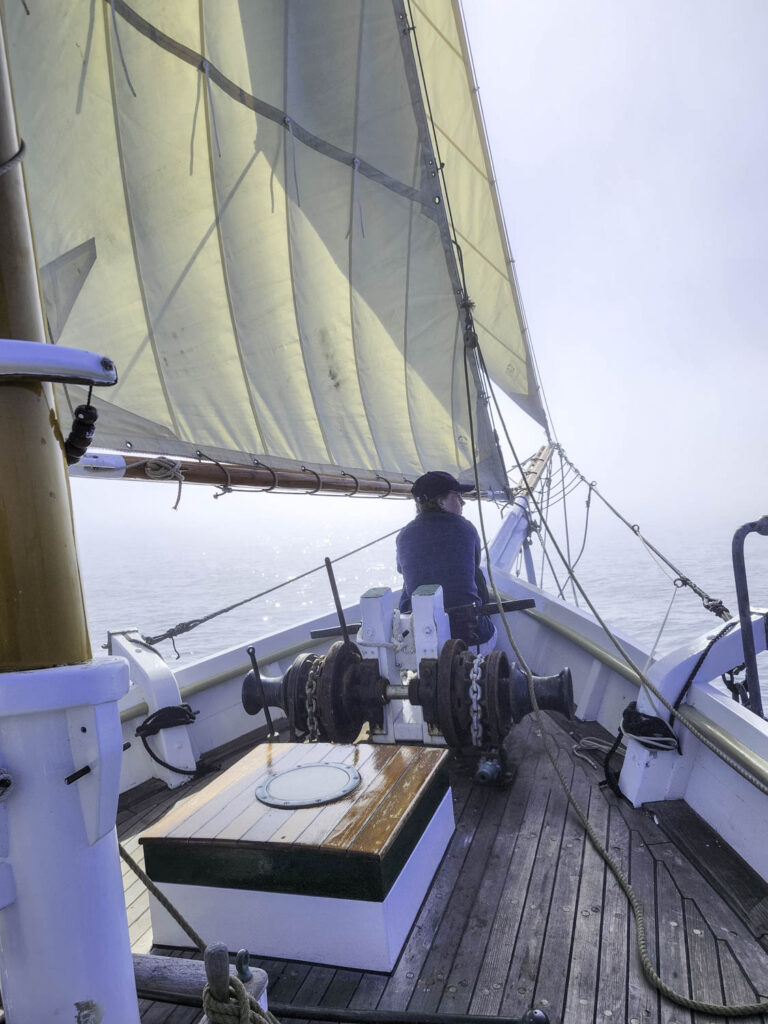
As we round Point Wilson, the fog lifts, and, in a display of the greatest contrast, Anse La Roche and crew are ushered along the sun-kissed Port Townsend waterfront before nestling into her slip at Point Hudson Marina. After a quiet and private evening in the harbor, the floodgates open and the festival takes full swing with boat rides, displays, lectures, and more. There is a lack of words to describe the energy of hundreds of wooden boats of all shapes and sizes, spit-shined and on display for thousands of mesmerized onlookers.
At the end of the day, a sail of any kind is a life-altering, perspective-shifting, and generally exhilarating experience. The gentle motion of the sea, the calming sounds, the intimate wildlife encounters, and enrichment of relationships brought through shared experiences usher the adventurous at heart into a state that lasts well beyond the duration of the journey itself. I often find that our guests depart with one of two impressions––the first being gratitude for a lasting memory and the second being the stark realization that they simply cannot return to the life they once led. I may not know what I want to be when I grow up, but I am certain that what I am doing now is beautiful, meaningful, purposeful, and impactful, and I’m confident that is enough.
 Kevin Pratt is the owner of Sail Anacortes. He’s a professional mariner, wooden boat enthusiast, carpenter, husband, and father. When he’s not sailing, he spends his time building boats and exploring with his family.