AdventuresNW



Paddling futilely like a one-winged albatross, I watched the bow of the balloon-like inflatable kayak swing inexorably broadside into the muddy four-foot waves. I struggled to straighten the lethargic rubber boat with my one good arm, but found myself wallowing imbalanced in the deepest trough.
“Oh my God,” I thought incredulously, “I’m going to flip.”
I clenched my left arm tight to my broken rib. With a snort halfway between disgust and hilarity, over I went into the warm, choppy water of Clarno Rapid on the John Day River. Sputtering to the surface, I furiously one-arm dog-paddled to shore while somehow dragging boat and paddle with my left arm still protecting my rib. I crawled up the algae-slick rocks and, dripping like a wet dog, inventoried my gear finding that all I’d lost was my pride, and more importantly, my hat.
How had it come to this, I wondered? A class V kayaker in a ducky dumping in the dinkiest rapid on the flattest river in the west?
Sasquatch and The Purple Sleeping Bag
Photo by Rob Gilchrist
It all started when paddling partners Tom, Andy, and I struck out on a northern California kayak tour, planning to hit the steep sections of the Smith, Scott, and Cal-Salmon, then dip farther south to Burnt Ranch on the Trinity and beyond. We headed out of White Salmon in Tom’s turd-brown Vanagon, and a little after dark, found a camping spot at the put-in of the Scott just as a storm was brewing. Tom elected to sleep in his van––a good call as my Walmart tent couldn’t hold up to the California tempest. Halfway through the night, I woke up soaked and shivering in my down sleeping bag and saw no other alternative than to crawl into Tom’s van and stretch out next to him. It crossed my mind that he had been struggling with a nasty cold, but when you’re young, you don’t worry about such things.
Tom’s a strong person, and his germs were no exception. I could hear them rattling deep in his lungs as his exhalations filled the van and condensed on the windows. Lulled by the pounding rain on the metal roof, I finally fell asleep, but knew I was breathing his sickness into my lungs all night.
Undeterred, we woke up to crisp morning sun and excitedly launched onto the river for our first run. We hooted and hollered down the Scott, shaking the night’s chill out of our bones, and hitch-hiked back to camp from the take-out.
I hit it hard, square in my back, came to a complete stop, then wrapped around the tree, suspended in midair, and as if in a cartoon, slowly slithered to the ground in a heap.
Andy had a slightly better tent than I did, but his gear and sleeping bag were also soaked. We realized that if we were going to keep this trip afloat, we had to dry our bags out. Reluctantly, we drove into the tiny nearby hamlet, a forested oasis with only a gas station and diner, and miraculously found a coin-operated washer and dryer tucked into the back corner of the cafe. We promptly stuffed in sleeping bags and clothing, filled the coin slots with quarters, and sat back while the clothes tumbled. The various dry pieces of clothing we had on were mismatched kayak and camp wear in shades of teal, neon green, and pink, and we became aware of suspicious stares from the burly local logger crowd.
After one cycle that basically did nothing to reduce the dampness, we concluded it would take hours and dollars to dry our stuff. At the counter, we exchanged bills for quarters, loaded the machine for the maximum time, and took off to sneak in another run before dark.
“What time do you close?” I asked the Sasquatch-huge man behind the counter.
“Six.”
It was after four, but blinded by ignorance and eagerness, we thought, “Sure, we can make it!” and headed out for another run. It was nearly eight before we pulled back into camp for a chilly night sleeping in whatever clothing we could scrape together. Morning again warmed our spirits, and we paddled all day before returning to the cafe, hoping for dry sleeping bags, but nervous that we might not find anything. Sure enough, none of our clothes were in the machines, on the floor, on the tables, or anywhere in sight. Sasquatch shrugged when we asked about our gear, and the townsfolk had nothing to say when I asked a few if they’d seen a purple sleeping bag.
Damn! That purple sleeping bag was important to me. Back east, my girlfriend at the time and I had bought matching bags that zipped together in preparation for a western road trip (that eventually led me to move to the Pacific Northwest). It was Mountain Hardware’s new ‘crazy leg’ design (stretchy at the knees), and by far the best sleeping bag I’d ever owned. It was a piece of the old life I’d carried into the new. By no means was I going to give up on it easily.
Slightly despondent, we passed another cold night and, in the morning, drove down to Otter Bar Kayak School, where we remembered our buddy Kirby used to teach kayaking. We found somebody who knew Kirby, explained the situation, and he happily loaned us two sleeping bags. Off we went with newfound energy, hitting the Smith, Scott, Cal-Salmon – four days of rock and liquid pleasure before Andy pulled a muscle in his back and we decided to head home.
Grandma Sally
Photo by Rob Gilchrist
Tired and satisfied, we returned the borrowed sleeping bags to Otter Bar and continued north, nearly passing the turn-off for the Cal-Salmon before I called, “Whoa, Tom, pull in!” He was going to pass the turn and our lost gear, without a second thought. I think that to Tom and Andy, the lost items were in the past, long gone, and they hadn’t been particularly attached to them to begin with. My family had always been good at finding things, at not giving up, and I knew with a little detective work, we stood a chance of seeing our belongings again.
“Richie, that stuff is gone for good,” Tom said, totally convinced.
They were eager to get home and had no desire to waste time. It took some convincing, but shortly they agreed to humor me, and we turned west, wound back up the Cal-Salmon, past our first camp, into the deserted little oasis. The bell jingled as we entered the cafe, but my hopes deflated as I saw an empty room, no purple sleeping bag in sight, only the same counter man slowly shaking his head no. One gruff man, who looked as if he might be Native American, gave me a sidelong glance as I walked by.
“You’re sure?” I asked the Sasquatch. “Any ideas?” No. He wagged his head with finality.
“Well, we tried,” said Andy flatly, and started for the door.
As I stood there, refusing to leave, I saw the mysterious man looking at me. As I caught his eye, he subtly indicated with a work-callused hand to come over. To my surprise, his face broke into a big grin as I approached.
“You looking for gear?”
“Yes,” I said, and briefly told him the story. He scribbled something on a scrap of paper and handed it to me. It said, ‘Grandma Sally,’ followed by a couple of turns indicating road directions. He handed it to me and pointed south down the road.
“So go south, then turn here and go through the woods?” I asked.
He shrugged, and his eyes seemed to cloud over again as he picked up his coffee cup. He sat stock still as if I weren’t there anymore.
I thanked him, and we retreated to the van. It was immediately evident that Tom and Andy wanted to throw in the towel.
“We’ll never find this,” Tom said, looking at the crude map. “It doesn’t even make sense. We gave it a good shot, but I want to get home before dark. Those things are gone.”
“C’mon, we’re here, let’s at least try. ” I cajoled.
Grudgingly, they once more consented, and we loaded into the van and drove in the direction the gruff man had pointed.
We bounced several miles down a rutted road before Andy said, “There!” and pointed at an almost unseen track snaking north into thick fir trees.
Devil’s club and vine maple closed in on us as we squeezed the Vanagon through a tunnel of greenery. Surely this was heading toward a dead end. Tom was looking anxiously for a place to turn around. Then, as suddenly as the thick canopy had shut out the sky, we emerged into brilliant light, into openness, a lush green yard, a white clapboard house stained like yellowed teeth with a swing on the wraparound porch. Swallows flitted around us, and a cool breeze brought me a memory of having iced tea on a southern lawn as a child.
Sitting in the swing, rocking gently, was a wizened, ageless woman with grey hair in a bun wearing an old-fashioned work dress and an apron. She had a twinkle in her eye that we could see from fifty feet away.
Tom shut the engine off, and we piled out. She stood up as if she’d been waiting for us, disappeared into the house, and reemerged, lugging two black garbage bags tied tightly with string. We moved to help her as she started down the steps.
“Hi,” we said in unison. “We left our clothes and …”
She merely smiled. Incredulous, I untied one of the bags, and there was Andy’s sleeping bag and our clothes, dried and neatly folded. In the other sack was my purple sleeping bag, fluffed up, cared for.
“How did you…” we began.
She shook her head. “I knew you’d come.”.
We tried to give her money, but she good-naturedly refused, just smiled and shooed us on our way. Weary, mystified, but content, we backtracked to the main road, turned north, and headed home.
CRUNCH!
Tom’s chest cold proved nasty indeed, and a day after we arrived home, it hit me hard. As I lay in bed shivering, I envisioned those little droplets of disease that had been condensing on his windows, finding nooks and crannies in my chest to proliferate. I had not been sick in a long time, and this one kept me bedridden for three days with a wracking cough and stuffed-up head. On the fourth day, feeling a little better and my aching body calling for something different, I decided a little fresh mountain air would do me good. In the past, I’d discovered that kayaking cold rivers helped cure a cold–– something about the ions in the air over moving water––and I hoped playing in the snow might prove the same. I dragged myself out from under the covers, clumsily loaded my snowboard, and drove up to the Mt. Hood Meadows ski hill for the day.
And what a day! To my surprise, like a prisoner emerging from a dark cell, brilliant sunlight shone on ten inches of fresh powder! We were in an inversion; the valley was cloaked in fog and clouds, but the top of the mountain was crystal clear. I tried to start easy, but the joy of riding took over, and I found myself exhilarated, plunging down steeps and deeps, lost in the world of snow, only half aware of how dazed I really was. Bursting out of the trees above Shooting Star Express, I hit a patch of windblown ice and skittered out of control, coming to a hard stop right at the base of a huge Doug Fir. I should have listened to what the tree was telling me, but I just sat up, laughed, brushed the snow from my goggles, and looked downhill for my next line. I pushed to my feet and kept going, my half-sick brain failing to acknowledge the close call and that I should maybe, just maybe, slow down.
Several buttery runs later, I came zipping out of a steep tree line into the most picturesque little clearing a snowboarder could hope to imagine. A fifty-foot circle of untouched snow, one small Doug fir standing plainly in the middle. I chose the beautiful arching line above the tree and, without slowing, leaned heelside, but at the last second, couldn’t resist the even tastier line swooping below the tree and shifted toeside. He who hesitates is lost, or in this case, he who changes his addled mind too late is doomed. My board caught the very edge of the tree well. Momentum flung me back-first into a thigh-sized Douglas fir tree. I found that even in the frozen northwest, small trees can be as immobile as a stone pillar. I hit it hard, square in my back, came to a complete stop, then wrapped around the tree, suspended in midair, and as if in a cartoon, slowly slithered to the ground in a heap.
Through the years, I’d taken some knocks that made it obvious I was hurt badly this time. I mentally checked my vitals, blinked my eyes, found I could wiggle my fingers and toes, and was slightly relieved. Still, I lay unmoving for half an hour, almost as if in a meditation. Finally, slowly, cautiously, hearing and feeling things move and crunch in my rib cage, I worked myself into a standing position on my snowboard, gingerly pointed my board downhill, and, with the utmost care, rode to my car. The only thing that impressed me about myself in this whole sordid episode was that I had the foresight to fill a plastic bag with snow and position it on my back before agonizingly settling myself into the car seat. Stinky and damp, I drove down the hill and got back in bed.
On the drive down, I’d discovered my hacking cough was not gone, and in bed, it seemed triply worse, each spasming cough shooting pain through my inflamed left rib cage and back. I’d lie perfectly still for as long as possible, but when the discomfort forced me to roll over, I felt and heard what sounded like bones rubbing and creaking against each other, and tried to deny that these sounds were my bones crunching.
For several days, I lay like that, sweating and coughing, until my buddy Ben helped me up and took me in for X-rays. There, the cheerful doctor informed me that yes! I had a broken rib, but no! he could not do anything about it. Don’t wrap it, don’t cast it. Give it time to heal.
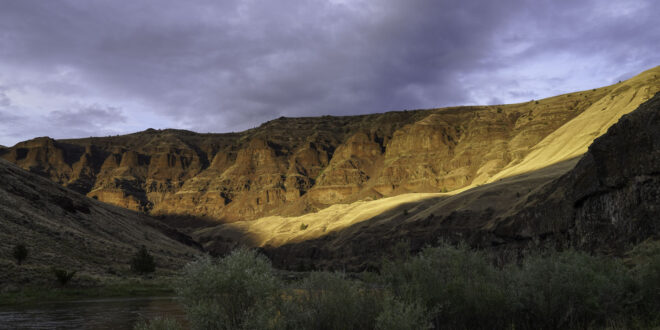
I stayed a week in that ripe bed, trying not to move, watching spring arrive through the window, until I began to feel a little better. Buds were popping out of branches, fresh snow was falling on the mountain, kayakers were hitting the rivers; I had to do something! Kayaking whitewater was out, as I couldn’t raise my left arm to shoulder height or take a full breath, but I’d heard of the John Day River and remembered my friend Stephen saying he’d taken his kids on multi-day trips there because it was flat, scenic, and had no rapids to speak of.
As a transplanted East Coast boater, all I knew were short, steep creeks filled with action. Waterfalls and boulder gardens, paddle hard for a few hours, beers at the takeout, do it all over again the next day. I had never considered paddling the John Day because there were no rapids; it was beneath my dignity as a steep creeker. I didn’t understand the mentality of multi-day trips. Why on earth would anyone want to paddle 100 miles of flatwater?
In my present state, though, I realized the John Day was just the ticket. Clutching my left wing to my chest like a wounded chicken, I borrowed Ben’s purple two-person AIRE inflatable kayak, threw my gear (including my recently rescued sleeping bag) into the one dry bag I owned, and drove through the desert to Clarno Bridge, the put-in for the main stretch of John Day River. I figured I’d hitch-hike back to my car at the end of the run, but with a borrowed boat and bowing to “the way it’s done” in the west, I arranged a shuttle for $60 with a nice old lady named Ruby who ran the business with her daughter. I’d leave my car at the Clarno Bridge, and four days later, she’d have it parked at the Cottonwood Bridge takeout.
Surveying the scene at the put-in, I was disgusted to see little kids bouncing and giggling on their parents’ rafts, cheap pool floaties tied to the backs of bulbous, over-packed tubes. I tried to convey with my stoic look and superior attitude that I was better than this. I’m a class V steep creeker, and only deign to run your river because I’m injured.
Other than a few canoe trips back east as a kid, I had never done a multi-day river trip, and to my surprise, as I topped the boat and prepared to launch, I realized I felt a touch of adventurous excitement creeping into my veins. I slung my dry bag into the front seat of the tandem boat and, as an afterthought, tied it in. The river was flat beneath the bridge, and I’d heard there was only one real rapid, Clarno Falls, at mile seven.
Gingerly, I pushed off and drifted downstream in the inflatable kayak. The kids, the cars, and the road faded away, and the bridge receded from sight. I spun lazily in the mild current, took in the tall grasses, the wind just beginning to pick up. The blue sky seemed filled with chittering kingfishers and cedar waxwings catching bugs; this was not so bad after all.
I had scoffed at rafting friends (not kayakers, mind you) mentioning “the rapid”, and as I rounded a bend and entered some small waves, I saw this was it. The whitewater grew, I bounced, winced, gritted my teeth, and disdainfully shook my head at this puny river. I had never paddled an inflatable kayak, much less with one arm, and found myself somewhat at odds with it. The beast was cumbersome and much harder to keep straight than a lithe kayak. Cresting a foamy wave, I saw the crux coming. A diagonal wave knocked my bow sideways offline, the weight and bulk of the boat wanting to give up and settle into the troughs like a fat pig. I grunted, clutched my left side, and swept my right blade, unsuccessfully trying to turn into the waves. I slid to the bottom of the trough, the arc of the largest wave lifting my upstream tube higher and higher until I began to tip.
“Oh my God,” I thought, “I’m going to flip.”
A Perfect Hat
Humbled, I sat on shore with my tail between my legs, feet splayed in the warm muddy water, rivulets running down my face and over my lips. I cautiously fingered my ribs and knew I had caused no further damage. My paddle was there on the rocks, my bag was still tied in, and the spring sun was already warming me. Then I began to laugh. I shook my head at all my foolishness, got back in the boat, and headed downstream.
That night, I camped on a sandy beach, watched the stars brighten over the rolling hills, and fell asleep to the sound of coyotes yip-yapping in the distance. The next day, as the scorching sun reached its apex, I realized I had to do something about not having a hat. At first, I tried to position my t-shirt on my head so that it would give my eyes some shade, but it kept shifting and was ineffective. I inventoried what I had and settled on the cardboard box from last night’s pasta dinner. I carefully split it at the seams, folded it into basically a pyramid shape, put it on my head, spread my t-shirt over it, and tied the shirt beneath my chin. Voila! A perfect hat. With my kinky hair halfway down my back, I must have looked like something between Jacob Marley and a sun-burned Rastafarian.
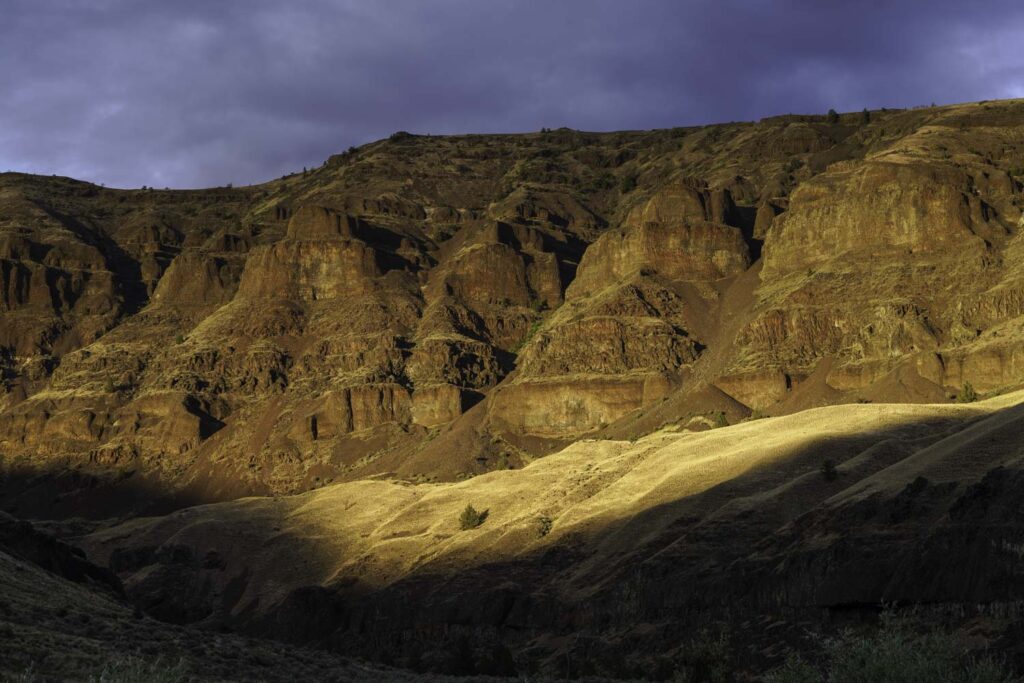
The days blended as I drifted the calm riffles beneath towering rock walls inundated with buzzing cicadas and crickets. Blue herons gawkily leap-frogged downstream with me. My makeshift hat performed admirably.
On the fourth day, I began to pass fishermen. I’d see them glance up, then double-take with scorn and puzzlement. Who, or what, is that? This pale, raw-boned, long-haired hippy, with sun-burned pink legs splayed out in a purple boat—and what the hell is that on his head? I smiled and nodded, as if I did this all the time.
Little did I know then that the John Day River would become a deep part of my family’s lore. When I eventually married and had children, we bought a family raft, a camp stove, and a table, and annual trips became rites of passage. We have a sturdy tent now, and my old purple sleeping bag, somewhat ragged but full of stories, served our oldest kid for several years. When winter shuts us in, there is time to sit by the woodstove and tell stories of days past, and when snow flies on the mountain, we get plenty of days in skiing and snowboarding. All the while, though, we are eagerly anticipating spring and the familiar peace of floating the John Day. We bring sunscreen, fishing rods, and books to lull the children asleep, along with the ancient murmur of the river.
And I always pack an extra hat.
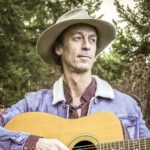 Richard Tillinghast has kayaked and camped from Nepal to the Pacific Northwest and now specializes in getting his children out into our wonderful world. He’s been everything from a horse wrangler to a raft guide to a musician. He lives in White Salmon, WA. Find more stories and songs at www.richardtillinghast.com.